
spec sheet7 rows
Acryol Pro is the Russian equivalent of EMLA cream, a eutectic mixture of 2.5% lidocaine and 2.5% prilocaine applied under occlusion to numb intact skin before needles, cannulation or minor procedures.
- Intact skin genuinely goes numb under an occlusive dressing
- Does exactly what the label claims, no interpretation required
- Eutectic lidocaine and prilocaine crossing the stratum corneum
- Worth a great deal before cannulation, needles or a tattoo
- The Russian equivalent of EMLA, sold as Acryol Pro
- Give it most of an hour under the dressing
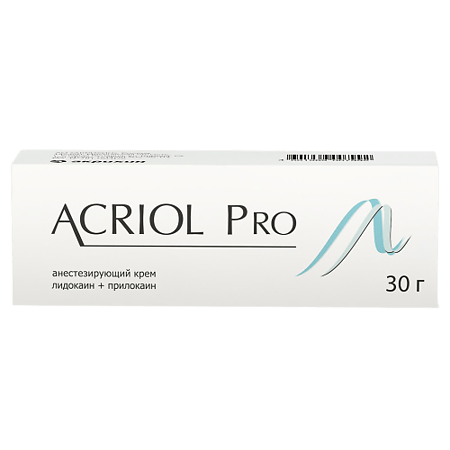
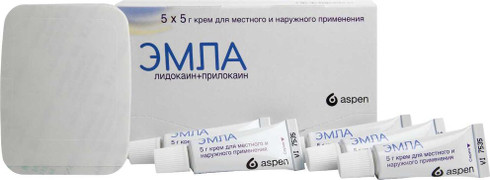
- EMLA is a eutectic mixture of lidocaine 2.5% and prilocaine 2.5% applied under occlusion, with published application times from 10 minutes to 3 hours [1].
- Efficacy is procedure-specific: across 11 neonatal studies it cut crying time and grimacing during circumcision but showed no benefit for heel lancing on any pain measure [1].
- Meta-analysis of those neonatal studies found no difference in methaemoglobin between EMLA and placebo at the doses used [1].
- In a 1,041-patient multicentre RCT of AV fistula puncture, EMLA cut mean VAS pain from 69.7 to 45.0, but a plain ice pack did better at 39.8 [2].
- Applied 3 hours before chest tube removal, EMLA blunted pain response more than IV morphine given 30 minutes before [3].
Mechanism
Combining the two anaesthetic bases produces a mixture that is liquid at room temperature, so the oil droplets carry a high free drug concentration through the stratum corneum. Once through, both block voltage gated sodium channels in the fine cutaneous nerve endings.
receptor fingerprint
Voltage-gated sodium channels in cutaneous nociceptor terminalsLidocaine and prilocaine free base released from the eutectic mixture block Nav channels, preventing action potential initiation in A-delta and C fibres
Haemoglobin iron, via the prilocaine o-toluidineOxidises ferrous to ferric haemoglobin faster than cytochrome b5 reductase can reduce it
Cutaneous immune recognition of lidocaineLidocaine within the cream can act as the sensitising agent in immediate-type and delayed-type hypersensitivity
Safetyrisks and cautions, not medical advice
prilocaine's metabolite oxidises haemoglobin, and methaemoglobinaemia is a real hazard when a large amount goes onto broken skin or mucosa, in infants, or alongside other oxidising drugs
Where to buy
1 other outlet
Suppliers
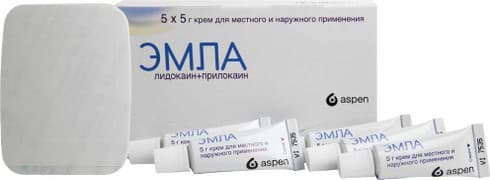
Vendors carrying EMLA Cream, with live product details and codes. Links are affiliate links that support the wiki at no cost to you.

RUPharma🌐
Acryol Pro
RUPharma🌐
EMLA Cream
Research
- 1994first citedEMLA.
- 1998meta-analysisA systematic review of lidocaine-prilocaine cream (EMLA) in the treatment of acute pain in neon…
- 2024most recentUsing cryotherapy, EMLA (eutectic lidocaine/prilocaine) cream, or lidocaine spray to reduce pai…
- 1.A systematic review of lidocaine-prilocaine cream (EMLA) in the treatment of acute pain in neonates.
- 2.Using cryotherapy, EMLA (eutectic lidocaine/prilocaine) cream, or lidocaine spray to reduce pain during arteriovenous fistula puncture: A randomized controlled trial.
- 3.Topical lidocaine-prilocaine cream (EMLA) for thoracostomy tube removal.
- 4.Methemoglobinemia induced by lidocaine-prilocaine cream.
- 5.Contact urticaria from Emla cream.
- 6.EMLA.
6 listed here; entry last updated August 2026
Reviews
My notesprivate to this device
Notes and cautions
- Methaemoglobinaemia is the defining risk: the prilocaine metabolite o-toluidine oxidises haemoglobin, documented in an 8-year-old after routine emergency-room application, with cyanosis unresponsive to oxygen and a saturation gap between blood gas and pulse oximetry as the clues, treated with IV methylene blue [4].
- Risk rises with excess dose, large surface area, prolonged contact, age under 12 months, and concurrent sulphonamides, nitrates or dapsone; it is contraindicated in congenital or idiopathic methaemoglobinaemia.
- Do not apply to broken skin, open wounds or the eye, and note that immediate-type hypersensitivity to the lidocaine component has been reported [5].