
spec sheet13 rows
Galantamine is a plant-derived alkaloid, isolated from snowdrops and related plants of the Amaryllidaceae family, used to treat the memory and thinking difficulties of mild-to-moderate Alzheimer's disease. It has an unusual dual action on the cholinergic system: it inhibits the enzyme acetylcholinesterase, and it separately acts as an allosteric potentiating ligand that binds a site distinct from the neurotransmitter's on nicotinic acetylcholine receptors, making them respond more strongly to acetylcholine. Marketed under names such as Razadyne and Reminyl, it has also been studied as a nerve-agent countermeasure and, more curiously, as an aid to lucid dreaming.
- Famous for vivid lucid dreaming and recall
- Memory and attention through the cholinergic system
- Does two cholinergic jobs at once
- Makes nicotinic receptors respond more strongly
- Plant derived, isolated from snowdrops
- Decades of clinical data behind it
- Nausea
- Vomiting
- Reduced appetite
Overview
Galantamine is a tertiary alkaloid of the Amaryllidaceae plant family, with the molecular formula C17H21NO3 and a fused, benzofuran-containing ring system. It occurs naturally in the bulbs and flowers of snowdrops (genus Galanthus), daffodils (Narcissus), Leucojum, and the red spider lily (Lycoris radiata), and it can also be prepared by chemical synthesis. In medicines it is generally formulated as the salt galantamine hydrobromide.
The compound was first isolated from snowdrop bulbs in eastern Europe around the middle of the twentieth century, and an industrial extraction process was developed by the Bulgarian chemist Dimitar Paskov, whose preparation was sold under the name Nivalin. Early clinical interest centered on its cholinergic, neuromuscular effects, including applications following poliomyelitis. From the late 1990s the alkaloid was developed as a treatment for dementia and gained regulatory approval around the turn of the millennium, later reaching the United States market as Reminyl and afterward as Razadyne [1][3].
Galantamine is approved for the symptomatic treatment of mild-to-moderate Alzheimer's disease, the most common cause of dementia. Pooled analyses of randomized, placebo-controlled trials have reported modest but reasonably consistent benefits for cognition, overall clinical status, and everyday function across treatment periods of several months [3]. It has also been examined in vascular dementia and in Alzheimer's disease accompanied by cerebrovascular disease [1]. As with other cholinergic drugs, its measurable action is symptomatic rather than disease-modifying, and it does not halt the underlying degenerative process.
Taken by mouth, galantamine is well absorbed, with a bioavailability near ninety percent and roughly linear pharmacokinetics; it binds only weakly to plasma proteins and is metabolized mainly in the liver by the CYP2D6 and CYP3A4 enzymes, giving an elimination half-life of several hours [1]. It is available as immediate-release tablets, an oral solution, and extended-release capsules, and a prodrug form, benzgalantamine, was approved in 2024.
Galantamine is a prescription-only medicine in the United States, the European Union, and most other jurisdictions. It is sold under several brand names, including Razadyne, Reminyl, and Nivalin, alongside numerous generic versions. Its most common adverse effects, shared with the wider class of cholinesterase inhibitors, are gastrointestinal, such as nausea and vomiting, and tend to appear when treatment begins or when the amount is raised [1].

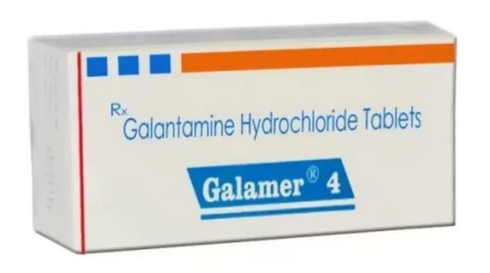
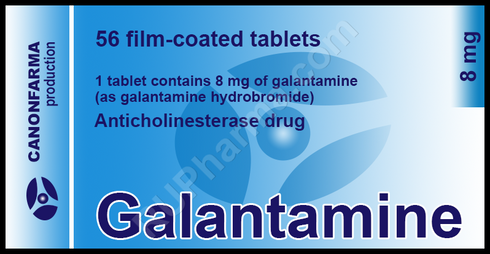
- Galantamine is extracted from snowdrops and daffodils, plants of the Amaryllidaceae family, giving a modern dementia drug distinctly botanical roots.
- It has two mechanisms at once: it blocks the enzyme that breaks down acetylcholine and separately makes nicotinic receptors more responsive to it.
- It has a notable following as an aid to lucid dreaming, taken to increase awareness during REM sleep.
Mechanism
Galantamine acts on the cholinergic system through two complementary mechanisms [1][2]. First, it is a reversible, competitive inhibitor of , the enzyme that degrades the neurotransmitter ; by slowing that breakdown it raises and prolongs acetylcholine levels at the , partially offsetting the cholinergic deficit that is a hallmark of Alzheimer's disease [1][3]. Second, and more distinctively, it behaves as an potentiating at neuronal receptors, binding to a site separate from the acetylcholine pocket and amplifying the receptor's response to acetylcholine and other agonists [2].
Because presynaptic receptors help govern the release of along with , , and , this action is thought to broaden the drug's influence on neurotransmission well beyond simple enzyme inhibition [2]. Unlike direct agonists, which tend to drive receptors into a desensitized state, potentiation operates only while the natural transmitter is present, an arrangement proposed to help sustain the effect over time [2]. The precise degree to which this action accounts for the observed clinical benefit remains a subject of continuing investigation [2].
receptor fingerprint
receptorsAllosteric potentiator
Reversible inhibitor
Cognitive declineSlower
Dosingtypical ranges, not medical advice
interested in protocols and clinical dosages? make an account to see them! ^_^
Safetyrisks and cautions, not medical advice
Galantamine is a real prescription drug, not a lightweight supplement, so treat it seriously. The most common issues are cholinergic: nausea, vomiting, diarrhea, stomach cramps, and loss of appetite, worst when starting or dosing up. It can slow the heart rate and cause dizziness or fainting, so it is cautioned in people with heart-rhythm or conduction problems, and it can aggravate asthma, COPD, ulcers, or urinary obstruction. Stacking it with other cholinergics (huperzine A, big choline doses) stacks the nausea and cramping too, so people keep those modest. For lucid dreaming the mid-sleep dosing can fragment sleep. Avoid casual daily use, and loop in a clinician if you have heart, lung, or GI conditions.
Interactionsdocumented pairs only, not exhaustive
Galantamine is cleared by CYP2D6 and CYP3A4, so inhibitors of either raise its exposure and with it the cholinergic side effect load. Paroxetine, a strong CYP2D6 inhibitor, increases galantamine bioavailability by roughly 40%, and ketoconazole raises the AUC by about 30%; quinidine, fluoxetine and the azole antifungals act the same way. What you get is more nausea, cramping and bradycardia rather than more cognitive benefit.
The pharmacodynamic interactions matter more. Anticholinergics such as oxybutynin, tricyclics and first generation antihistamines work directly against galantamine at muscarinic receptors, and each blunts the other. Adding a second cholinesterase inhibitor or a direct cholinergic agonist like bethanechol produces additive cholinergic excess.
Galantamine also has a vagotonic effect on the sinoatrial and atrioventricular node, so pairing it with beta blockers, digoxin or other rate slowing drugs raises the risk of symptomatic bradycardia and syncope. Under anaesthesia it exaggerates succinylcholine type neuromuscular blockade.
Checking a whole stack? Run it through interactions + stacks.
History
Galantamine is a naturally occurring alkaloid isolated from snowdrops and related plants of the Amaryllidaceae family, and its story reaches back to mid-twentieth-century research in the Soviet Union and Eastern Europe. Pharmacologists there first developed it under the name Nivalin for neuromuscular conditions, reportedly including the aftereffects of poliomyelitis, drawing on its ability to inhibit the enzyme acetylcholinesterase. Decades later, as the cholinergic deficit of Alzheimer's disease became a central therapeutic target, galantamine was repurposed as a cognitive treatment.
It gained regulatory approval around 2001, marketed under brand names such as Reminyl and, in the United States, Razadyne, for mild-to-moderate Alzheimer's disease. What distinguishes galantamine from other cholinesterase inhibitors is its second mechanism: it acts as an allosteric potentiating ligand at nicotinic acetylcholine receptors, amplifying their response to acetylcholine. Beyond dementia, it has been studied as a countermeasure to nerve agents and, more curiously, has developed a following as an aid to lucid dreaming, reflecting its far-reaching effects on the cholinergic system.
Reputation
Galantamine is well respected as one of the standard cholinesterase inhibitors for mild-to-moderate Alzheimer's disease, valued for a dual mechanism that sets it apart from its peers. Meta-analyses of randomized, placebo-controlled trials consistently show that it improves cognitive scores relative to placebo, placing it firmly among the evidence-based options for slowing the symptoms of decline.
Its plant-derived origins and unusual allosteric action on nicotinic receptors give it a distinctive scientific appeal, and it has attracted research interest for neuroprotection well beyond dementia. Among the wider community it is also known, intriguingly, for its use as a tool to promote lucid dreaming. It is a symptomatic treatment rather than a cure, and like all cholinergic drugs it can cause nausea and gastrointestinal effects, especially when first started. For a naturally sourced molecule with a genuine clinical track record, galantamine holds a deservedly solid reputation.
Subjective profileweighing the evidence above
The lucid-dreaming use is a rare case of internet lore with a controlled trial behind it, and the mid-sleep dose does work. It is still a prescription cholinergic, with nausea and vomiting on the way up and a slowed heart rate to respect, so occasional use is one thing and daily dosing in a healthy brain is not the point of it.
Where to buy


Suppliers
Vendors carrying Galantamine, with live product details and codes. Links are affiliate links that support the wiki at no cost to you.
PCT.Zone
Galantamine

RUPharma🌐
Galantamine
RUPharma🌐
Galantamine
Research
- 2000first citedAllosteric modulation of nicotinic receptors as a treatment strategy for Alzheimer's disease
- 2015meta-analysisEfficacy and safety of galantamine treatment for patients with Alzheimer's disease: a meta-anal…
- 2024most recentEvaluating the efficacy and safety of Alzheimer's disease drugs: a meta-analysis and systematic…
- 1.Clinical pharmacokinetics of galantamine
- 2.Allosteric modulation of nicotinic receptors as a treatment strategy for Alzheimer's disease
- 3.Galantamine for Alzheimer's disease.
- 4.Allosteric sensitization of nicotinic receptors by galantamine, a new treatment strategy for Alzheimer's disease
- 5.The nicotinic allosteric potentiating ligand galantamine facilitates synaptic transmission in the mammalian central nervous system
- 6.Galantamine is an allosterically potentiating ligand of neuronal nicotinic but not of muscarinic acetylcholine receptors
- 7.Competitive antagonism between the nicotinic allosteric potentiating ligand galantamine and kynurenic acid at alpha7* nicotinic receptors
- 8.Galantamine prevents apoptosis induced by beta-amyloid and thapsigargin: involvement of nicotinic acetylcholine receptors
- 9.Unequal neuroprotection afforded by the acetylcholinesterase inhibitors galantamine, donepezil, and rivastigmine in SH-SY5Y neuroblastoma cells: role of nicotinic receptors
- 10.Efficacy and safety of galantamine treatment for patients with Alzheimer's disease: a meta-analysis of randomized controlled trials
- 11.Efficacy of galantamine in probable vascular dementia and Alzheimer's disease combined with cerebrovascular disease: a randomized trial
- 12.Safety and efficacy of galantamine in subjects with mild cognitive impairment
21 listed here; entry last updated August 2026
Reviews
My notesprivate to this device
FAQ
Is galantamine safe to just try casually?
It is a prescription drug with real cardiac and GI effects; treat it seriously and ideally involve a clinician, not as a lightweight supplement.
Why do people use it for lucid dreaming?
Taken after a few hours of sleep it boosts acetylcholine during REM, which sharpens dream vividness and awareness.
Can I stack it with other choline sources?
Cautiously; combining cholinergics amplifies nausea and cramping, so people often pair it with choline only in modest amounts.
Adverse effects
- Nausea
- Vomiting
- Reduced appetite
- Dizziness