
spec sheet13 rows
Donepezil is a medication used to treat the symptoms of dementia in Alzheimer's disease. It belongs to a class of drugs called cholinesterase inhibitors, which work by boosting levels of the signaling chemical acetylcholine in the brain. Developed by the Japanese company Eisai and approved in the United States in 1996 under the brand name Aricept, it is one of the most widely prescribed treatments for Alzheimer's dementia. Donepezil eases symptoms modestly but does not stop or reverse the underlying disease.
- Stops acetylcholine from breaking down
- More acetylcholine means stronger cholinergic tone
- Prescribed to support memory in Alzheimer's
- Long acting and steady through the day
- One of the most prescribed cholinesterase inhibitors
- Commonly nausea, diarrhea, or loss of appetite
- May cause insomnia, vivid dreams, or muscle cramps
- Can slow the heart rate, so caution is advised with certain heart conditions
Overview
Donepezil is a centrally acting, reversible inhibitor of the enzyme acetylcholinesterase, placing it in the class of drugs known as cholinesterase inhibitors [2]. It was developed by the pharmaceutical company Eisai, with a research team led by Hachiro Sugimoto, and was approved in the United States in 1996 [2]. It is marketed under the brand name Aricept and is now available as an inexpensive generic medicine [1].
The drug is used to treat the cognitive and functional symptoms of dementia caused by Alzheimer's disease, and it is approved for mild, moderate, and severe stages of the illness [1]. It has also been used, sometimes outside its formal approvals, in other forms of dementia, including dementia associated with Parkinson's disease, vascular dementia, and dementia with Lewy bodies [2]. Donepezil is a symptomatic treatment: it can improve or stabilize symptoms for a time but does not change the course of the underlying degenerative process [1].
Systematic reviews of controlled trials have concluded that donepezil produces small but measurable benefits in thinking, everyday function, and overall clinical impression in people with Alzheimer's dementia, generally over treatment periods of a few months [1]. A large, long-term British trial known as AD2000 similarly reported cognitive and functional benefits but did not find significant effects on major outcomes such as the need for institutional care or the progression of disability [3]. Because the benefits are modest and not universal, guidelines suggest reviewing treatment and stopping it if no worthwhile effect is seen [1].
Donepezil is taken once daily, usually as an oral tablet, including a form that dissolves in the mouth, and it is also available as a skin patch [1][2]. It is a prescription-only medicine and appears on the World Health Organization's list of essential medicines. Its side effects arise mainly from its cholinergic action and are usually mild and temporary, most often nausea, diarrhea, loss of appetite, difficulty sleeping, and muscle cramps; less commonly it can slow the heart rate, so caution is advised in people with certain heart-rhythm conditions [1][2].

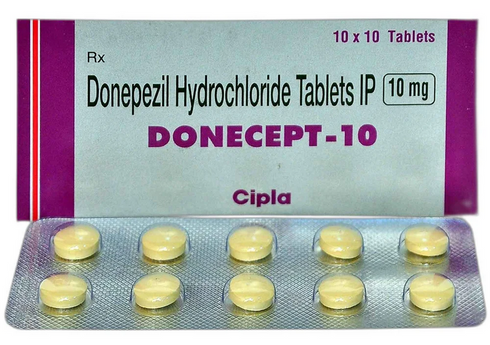
- Donepezil began life as Eisai's internal compound E2020 before it was ever named.
- It is a potent and selective acetylcholinesterase inhibitor, with a reported IC50 in the single-digit nanomolar range.
- Beyond blocking acetylcholinesterase, donepezil has been reported to act as a sigma-1 receptor agonist, a property under study for additional neuroprotective effects.
Mechanism
In Alzheimer's disease, nerve cells that use the neurotransmitter are progressively lost, and this decline in cholinergic signaling is linked to the memory and thinking problems that characterize the illness [2]. Donepezil works by reversibly blocking , the enzyme that normally breaks down after it is released [1][2]. By slowing this breakdown, the drug raises and prolongs levels at synapses in the brain, partially compensating for the reduced cholinergic activity and temporarily supporting cognitive function [2]. Because it does not address the underlying loss of neurons, its effect is symptomatic rather than curative [1]. Donepezil has additionally been reported to act as an at the sigma-1 receptor and to influence receptors, actions that may contribute to its effects [2].
receptor fingerprint
selective inhibitor
Sigma-1 receptoragonist
Cholinergic signaling (, )strengthens
Hippocampal atrophyslows
Dosingtypical ranges, not medical advice
interested in protocols and clinical dosages? make an account to see them! ^_^
Safetyrisks and cautions, not medical advice
The common side effects are cholinergic: nausea, diarrhea, stomach cramps, appetite loss, vivid dreams or insomnia (take it earlier if the dreams get disruptive), muscle cramps and a slowed heart rate. Because it slows the heart it can cause fainting or trouble in people with certain rhythm problems, and it can aggravate asthma or COPD, ulcers, and urinary obstruction. Rare but serious issues include heart block, seizures and GI bleeding. Do not casually stack it with other acetylcholinesterase inhibitors like huperzine A, since the cholinergic effects add right up, and a big overdose causes a cholinergic crisis.
Interactionsdocumented pairs only, not exhaustive
Donepezil raises synaptic acetylcholine, so its sharpest interactions are with drugs pulling the other way. Anticholinergics such as oxybutynin, benztropine, sedating antihistamines and tricyclics blunt its cognitive effect while it blunts theirs; the pairing is common in older patients and quietly cancels both.
The cardiac issue is vagotonic. Donepezil slows sinus and AV node conduction, and case series document bradyarrhythmia and syncope after it is started, in some patients leading to pacemaker implantation. Beta blockers, digoxin, verapamil and diltiazem add to that and can produce heart block. Under anesthesia, cholinesterase inhibition prolongs the action of succinylcholine.
Metabolism runs through CYP3A4 and CYP2D6, so ketoconazole, paroxetine and quinidine raise donepezil exposure, while rifampin, carbamazepine and phenytoin lower it. Cholinergic drive also increases gastric acid secretion, which compounds the ulcer and bleeding risk of NSAIDs.
Checking a whole stack? Run it through interactions + stacks.
History
Donepezil was discovered by the Japanese pharmaceutical company Eisai, where a research team led by the chemist Hachiro Sugimoto set out in the 1980s to design a well-tolerated, long-acting inhibitor of acetylcholinesterase for Alzheimer's disease. The molecule that emerged, then known as E2020, was selected from a large series of piperidine-based compounds for its potency and favorable pharmacokinetics.
It received United States approval in 1996 under the brand name Aricept, becoming the second cholinesterase inhibitor cleared for Alzheimer's after tacrine but offering once-daily dosing and a substantially better safety profile. Over the following years its use expanded from mild-to-moderate to severe Alzheimer's dementia, a higher 23 mg formulation was introduced, and a once-weekly transdermal patch was later approved. Donepezil has since become one of the most widely prescribed treatments for Alzheimer's dementia worldwide and a standard comparator in dementia research.
Reputation
Donepezil holds an established place in dementia care as a dependable, well-studied first-line option whose benefits, while modest, are real and reproducible. Cochrane and other systematic reviews consistently find small but measurable improvements in cognition, global clinical impression, and daily function across mild, moderate, and severe stages of Alzheimer's disease. Clinicians value its simple once-daily dosing, decades of accumulated safety experience, and low cost as a generic. It is honest to emphasize that donepezil treats symptoms rather than the underlying disease; it neither halts nor reverses neurodegeneration, and its gastrointestinal and cholinergic side effects lead some patients to discontinue. Even so, for many families it provides a worthwhile period of stabilized function, which explains its enduring status as a benchmark therapy.
Subjective profileweighing the evidence above
A reasonable prescription for Alzheimer's symptoms, where modest relief is still worth having. As an off-label nootropic it is a poor trade: the nausea, vivid dreams and slowed heart rate show up whether or not the cognitive benefit does, and it does nothing to the disease itself.
Where to buy

1 other outlet

Suppliers
Vendors carrying Donepezil, with live product details and codes. Links are affiliate links that support the wiki at no cost to you.
PCT.Zone
Donepezil
RUPharma🌐
Donepezil
Research
- 1999first citedAbsorption, distribution, metabolism, and excretion of donepezil (Aricept) after a single oral…
- 2018meta-analysisDonepezil for dementia due to Alzheimer's disease.
- 2025most recentDonepezil for cancer-related cognitive impairment: systematic review and meta-analysis.
- 1.Donepezil for dementia due to Alzheimer's disease.
- 2.Donepezil: a review
- 3.Long-term donepezil treatment in 565 patients with Alzheimer's disease (AD2000): randomised double-blind trial
- 4.Classics in Chemical Neuroscience: Donepezil.
- 5.[Pharmacological properties of donepezil hydrochloride (Aricept), a drug for Alzheimer's disease].
- 6.Impaired attention in the 3xTgAD mouse model of Alzheimer's disease: rescue by donepezil (Aricept).
- 7.Donepezil attenuates vascular dementia in rats through increasing BDNF induced by reducing HDAC6 nuclear translocation.
- 8.Donepezil ameliorates oxygen-glucose deprivation/reoxygenation-induced brain microvascular endothelial cell dysfunction via the SIRT1/FOXO3a/NF-κB pathways.
- 9.Absorption, distribution, metabolism, and excretion of donepezil (Aricept) after a single oral administration to Rat.
- 10.Cholinesterase inhibitors for Alzheimer's disease.
- 11.Donepezil for mild cognitive impairment.
- 12.Cholinesterase inhibitors for delirium.
21 listed here; entry last updated August 2026
Reviews
My notesprivate to this device
FAQ
How does donepezil work?
It inhibits acetylcholinesterase, the enzyme that breaks down acetylcholine, raising available acetylcholine levels.
What is it approved for?
It is used to treat symptoms of Alzheimer's disease.
Why is it sometimes taken at night?
Evening dosing is common, though vivid dreams can lead some people to take it in the morning instead.
What are common side effects?
Gastrointestinal effects like nausea and diarrhea are among the most common.
Adverse effects
- Commonly nausea, diarrhea, or loss of appetite
- May cause insomnia, vivid dreams, or muscle cramps
- Can slow the heart rate, so caution is advised with certain heart conditions
- Eases symptoms but does not halt the disease