
spec sheet9 rows
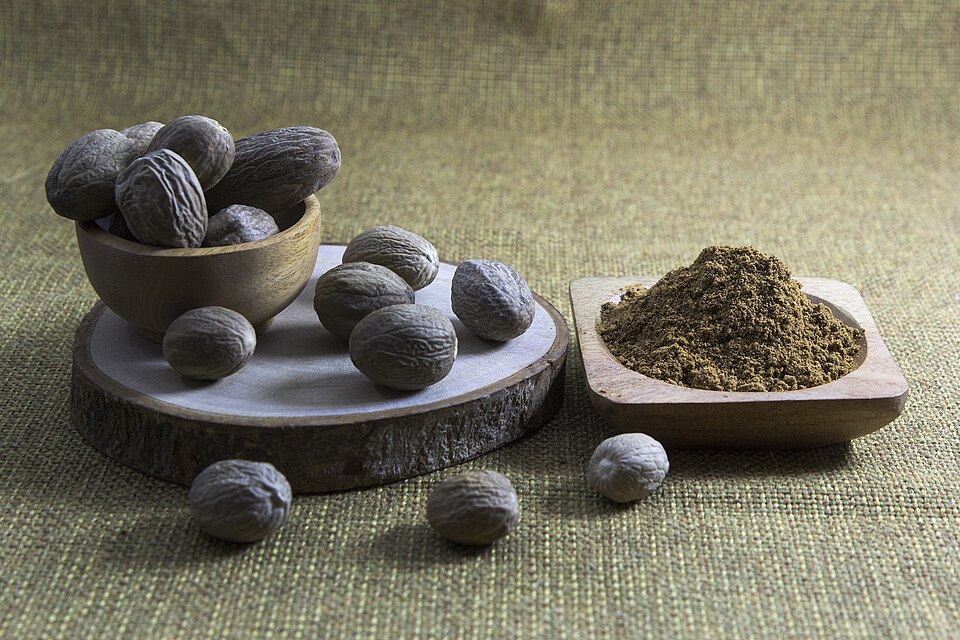
Nutmeg is the culinary spice obtained from the seed of Myristica fragrans, the same tree whose seed covering yields mace. Culinary quantities are inert, but very large ingestions of the ground seed can cause a slow-onset, long-lasting intoxication attributed chiefly to the aromatic constituents myristicin, elemicin, and safrole, often accompanied by anticholinergic-like features such as tachycardia and agitation. Myristicin is additionally reported to possess weak monoamine oxidase inhibitory activity, and its structural resemblance to amphetamine precursors has prompted speculation about amphetamine- or MDMA-like metabolites, though such conversion in humans remains unproven. Case series and poisoning reports characterize the experience as unpredictable and generally unpleasant; documented exposures have required medical evaluation but have not typically been life-threatening, and toxicokinetic analysis of the psychoactive constituents in serum has been performed in overdose cases.
- Valued as a culinary spice for flavor
- Long history in traditional medicine and cooking
- No established recreational benefit; the high-dose experience is generally regretted
- High-dose myristicin produces slow-onset deliriant intoxication
- Nausea, vomiting, and dry mouth
- Rapid heartbeat, dizziness, and flushing
- Confusion and an anticholinergic-like delirium at high doses
- A prolonged, unpleasant multi-day hangover
Mechanism
Nutmeg's psychoactivity comes mainly from two volatile phenylpropene oils, myristicin and elemicin. Their exact central mechanism is not fully pinned down, but the intoxication has a strongly anticholinergic (deliriant) character; dry mouth, flushing, confusion, and a foggy, dreamlike delirium, which is why it is grouped with the deliriants rather than the classic psychedelics. Myristicin is also a weak, reversible inhibitor of monoamine oxidase (the enzyme that breaks down , , and noradrenaline), so at high intake it behaves as a mild . A popular and much-repeated idea is that the body converts myristicin and elemicin into amphetamine- or MDMA-like (MMDA) or even cannabinoid-like metabolites; this remains speculative and is not well established in humans.
receptor fingerprint
Central cholinergic/anticholinergic signalingAnticholinergic-like deliriant action (via myristicin and elemicin)
Monoamine oxidase (MAO)Weak reversible inhibitor (via myristicin)
Safetyrisks and cautions, not medical advice
In normal culinary amounts nutmeg is safe; the danger is entirely dose-dependent. High doses cause a rough, prolonged toxicity; nausea and vomiting, a racing heart, dizziness, dry mouth, agitation, and an anticholinergic-flavored delirium that is usually frightening rather than fun, followed by a hangover that can drag on for a day or more. Because myristicin acts as a mild MAO inhibitor, large amounts carry the classic MAOI cautions; combining it with tyramine-rich aged or fermented foods (aged cheese, cured meats, some wines) can in theory raise blood pressure, and stacking it with serotonergic drugs (SSRIs and other antidepressants, certain migraine or pain medicines, MDMA) risks serotonin syndrome, a dangerous overload of serotonin. Not medical advice.
Subjective profileweighing the evidence above
Excellent in a custard, miserable as a drug. The high-dose experience is a slow, day-long anticholinergic-flavored delirium with vomiting, a racing heart and a hangover that outlasts it, and almost nobody who tries it does it twice.
Resources
This entry is here for reference.
Research
- 1963first citedEvidence of monoamine oxidase inhibition by myristicin and nutmeg.
- 2023most recentDetection of major psychoactive compounds (safrole, myristicin, and elemicin) of nutmeg in huma…
- 1.Toxicological evaluation of myristicin.
- 2.Acute nutmeg intoxication.
- 3.Evidence of monoamine oxidase inhibition by myristicin and nutmeg.
- 4.Detection of major psychoactive compounds (safrole, myristicin, and elemicin) of nutmeg in human serum via GC-MS/MS using MonoSpin extraction: Application in a nutmeg poisoning case.
- 5.The spice of life: an analysis of nutmeg exposures in California.
5 listed here; entry last updated July 2026
Reviews
My notesprivate to this device
FAQ
Is nutmeg in food dangerous?
No. The amounts used in cooking and baking are far below anything psychoactive; the risk only appears at the very large doses people take deliberately to get high.
Does nutmeg really get you high?
At high doses, yes, but it is a slow, long, and by most accounts miserable deliriant intoxication with heavy nausea and a lingering hangover, not a pleasant recreational experience.
Is nutmeg an MAOI?
Weakly. Its component myristicin mildly inhibits monoamine oxidase, so at high intake the standard MAOI cautions apply; watch tyramine-rich foods and avoid combining it with serotonergic drugs.
Adverse effects
- Nausea, vomiting, and dry mouth
- Rapid heartbeat, dizziness, and flushing
- Confusion and an anticholinergic-like delirium at high doses
- A prolonged, unpleasant multi-day hangover