
spec sheet5 rows
Compound 7P is a laboratory label rather than a chemical name. It refers to 2-(N-(2-methoxyphenyl)-4-methylphenylsulfonamido)-N-(4-methoxypyridin-3-yl)acetamide, a sulfonamidoacetamide that came out of a phenotypic screen of about 170,000 synthetic small molecules run to find compounds that make neurons grow processes [2]. In culture it promoted neurite outgrowth in primary neurons from the hippocampus, the cerebral cortex and the retina, and in an animal model of optic nerve injury it induced the growth of GAP-43 positive axons [1]. No molecular target and no signaling pathway has been assigned to it; the paper that reported it named mechanism as work still to be done [1]. There is no human data of any kind.
- Makes neurons grow new processes
- Grew axons after optic nerve injury in animals
- Worked across hippocampal, cortical and retinal neurons
- Plucked from a screen of 170,000 molecules
- A lead compound for axon regeneration
- Optimized for high metabolic stability
Overview
Compound 7P is the label one 2016 paper used for one molecule in its own internal numbering, and that is worth saying before anything else, because the label is not unique. The actual identity is a sulfonamidoacetamide, 2-(N-(2-methoxyphenyl)-4-methylphenylsulfonamido)-N-(4-methoxypyridin-3-yl)acetamide, sold under CAS 1890208-58-8. At least three unrelated molecules in the literature carry the label "compound 7p", one of them a 1990s thromboxane agent with nothing to do with this one, so a page or a supplier listing that matches only on the name may be describing a completely different chemical.
It was found by phenotypic screening. About 170,000 synthetic small molecules were tested for the ability to make neurons extend processes, first in P19 embryonal carcinoma cells and rat primary hippocampal neurons; the active compounds shared a sulfonamidoacetamide core, and chemists then modified that core step by step, guided by which changes kept the activity, until they reached this molecule [2]. Screening of that kind selects for an effect and says nothing about the target. That is exactly the situation here: the molecule works in the dish and nobody has established how.
What it was shown to do is narrow and real. In culture it promoted neurite outgrowth in primary neurons taken from the hippocampus, the cerebral cortex and the retina, and in an animal model of optic nerve injury it induced the growth of axons carrying GAP-43, a protein neurons switch on while a fibre is actively regrowing rather than merely surviving [1]. The adult central nervous system regenerates fibres very poorly, so a small molecule that gets axons to regrow at all is a genuinely interesting result. The record stops there. PubMed's substance index attaches this exact structure to a single article, and the only other indexed mention is a 2017 editorial that summarized the work [2]; there is no clinical study, no human exposure report, no pharmacokinetics, and no cognitive measurement in any species. It is a research chemical, not a medicine or a supplement, and its profile should be read as one early result rather than as a body of evidence.
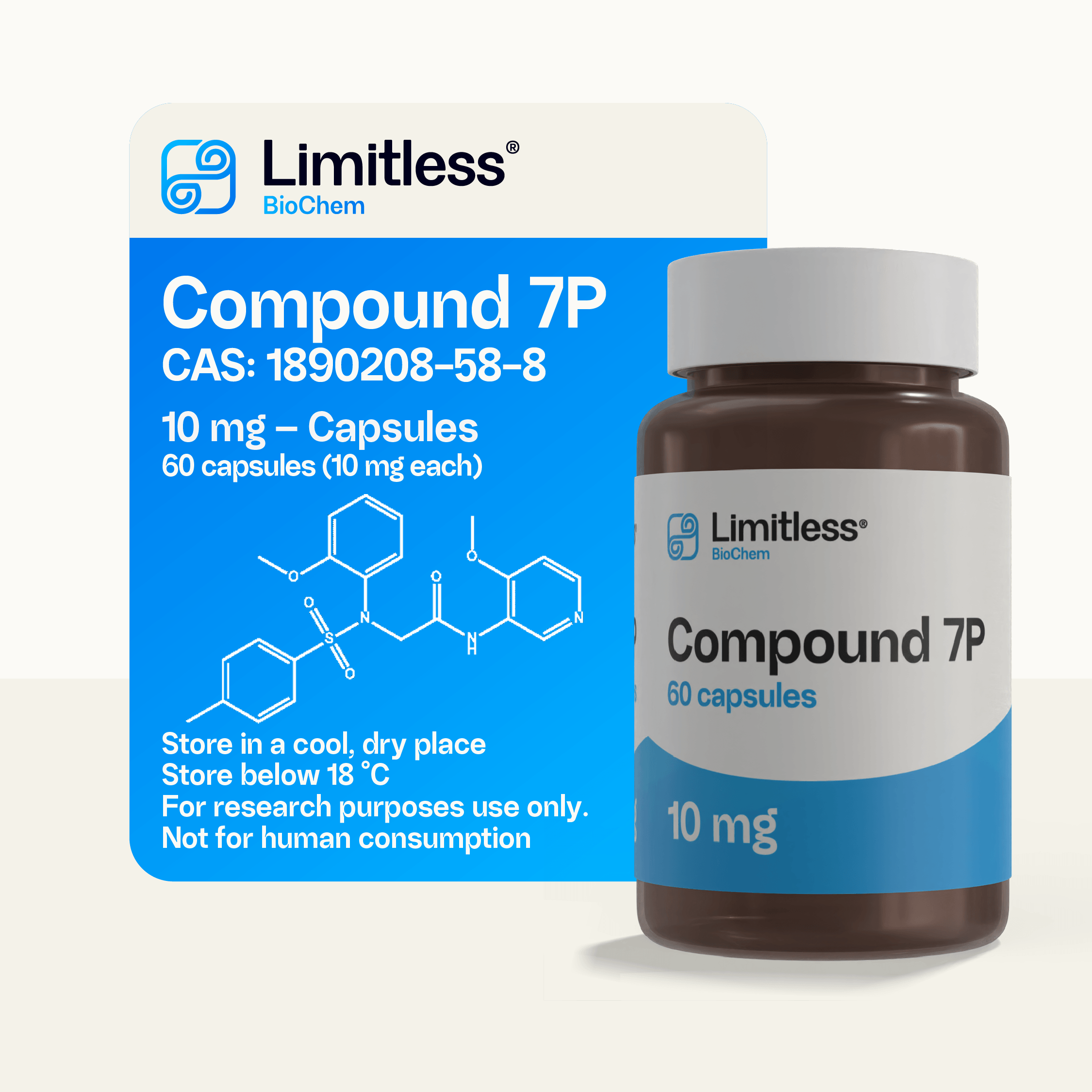
- The compound was never designed against a target. It came out of a phenotypic screen of about 170,000 synthetic small molecules chosen purely for making neurons grow processes, and no target has been assigned to it since.
- The name is the problem. "Compound 7p" is a paper-internal label rather than a chemical name, and at least three unrelated molecules carry it, which is how thromboxane pharmacology belonging to a 1990s Zeneca compound ended up attached to this one.
Mechanism
No mechanism of action has been established for this compound, and that is the single most important thing on this page. It was found by phenotypic screening, which means it was selected for what it did to living cells and not for binding anything in particular. About 170,000 synthetic small molecules were screened for the ability to make neurons extend processes, initially in P19 embryonal carcinoma cells and rat primary hippocampal neurons; the hits shared a sulfonamidoacetamide core, and structure-activity guided optimization of that scaffold produced the molecule this page is about [2]. A screen built that way returns an effect, never a target.
The effect itself is documented. In culture the compound promoted neurite outgrowth in primary neurons taken from the , the cerebral and the retina [1]. In an animal model of optic nerve injury it induced the growth of GAP-43 positive axons; GAP-43 is the growth-associated protein a neuron switches on while a fibre is actively regrowing, so the marker is the evidence that fibres were regrowing rather than merely surviving, and the authors read it as the culture activity carrying over into a living animal [1]. A 2017 editorial reviewing the year's medicinal chemistry described the same work and added that the optimized molecule had relatively high metabolic stability [2].
Everything between the compound and that effect is unknown. Neither source assigns it a receptor, an enzyme, a transporter or a signaling pathway, and the primary paper closes by naming mechanism as work still to be done, saying that further optimization and elucidation of the mechanisms by which it elicits axon regeneration in vivo would provide a rational basis for future efforts [1]. Three mechanisms have nonetheless circulated for this compound in secondary write-ups: thromboxane and prostacyclin rebalancing, and STAT3 signaling, and and signaling. None of the three appears anywhere in either published source, and the thromboxane version belongs to a different molecule that happens to share the same paper-internal label. The silence here is not stylistic; the mechanism genuinely has not been identified, and no cognitive endpoint has been measured for this compound in any species.
Dosingtypical ranges, not medical advice
interested in protocols and clinical dosages? make an account to see them! ^_^
Safetyrisks and cautions, not medical advice
There is no human safety information for this compound. No clinical study, no reported human exposure, no pharmacokinetics and no toxicology appear in the published record, which consists of one preclinical paper and one editorial summarizing it [1][2]. Because no mechanism has been identified, there is also no basis for predicting which organ systems it would act on or what it would interact with; an unidentified mechanism is an absence of information rather than a reassurance. Identity is a hazard in its own right here: "compound 7p" is a paper-internal label and at least three unrelated molecules carry it, so a supplier printing the name is not evidence of what is in the vial. Confirm by CAS 1890208-58-8 or by structure.
History
The origin is specific and documented, which is the opposite of what the entry has been saying. The compound was reported in May 2016 in the Journal of Medicinal Chemistry by a group at the Bio-Center of the Gyeonggi Institute of Science and Technology Promotion in Suwon, Korea, with collaborators in the Department of Applied Chemistry at Ajou University and the Department of Pharmacy at Hanyang University; Jin-Mo Ku is the first author and Yongmun Choi, at the same Bio-Center, is the last-listed author [1].
The work began as a phenotypic screen of about 170,000 synthetic small molecules and reached this molecule by structure-activity guided optimization of the sulfonamidoacetamide scaffold the active compounds shared [2]. "Compound 7p" is that paper's own numbering rather than a name anyone conferred on the molecule, which is why the same label turns up on unrelated compounds in unrelated papers. PubMed's substance index attaches this exact structure to a single article, and the only other indexed mention is the 2017 editorial that summarized the work [2].
Reputation
Interest in this compound rests on one endpoint: axons regrowing after optic nerve injury, which the adult central nervous system does badly and which few small molecules have produced at all [1]. That is a reasonable thing to find interesting. The discussion around it has drifted well past the evidence, though, and the mechanisms it gets credited with in secondary write-ups, thromboxane and prostacyclin rebalancing, mTOR and STAT3 signaling, and TrkB and BDNF signaling, appear in neither published source [1][2]. Part of that drift is a naming accident: "compound 7p" is a label three unrelated molecules share, and pharmacology belonging to one of the others has been copied onto this one. On its own record it is a single preclinical result with no mechanism, no human data and no cognitive measurement, which makes it a research lead rather than a compound with a profile.
Subjective profileweighing the evidence above
One real preclinical result and no mechanism behind it. Axons regrowing after optic nerve injury is a hard endpoint and this compound produced it, which is the reason the entry exists; everything past that, target, pathway, human dose, safety, is blank, and blank is what the entry should say. A research lead, not something to take.
Where to buy

1 other outlet

Suppliers
Vendors carrying Compound 7P, with live product details and codes. Links are affiliate links that support the wiki at no cost to you.
Kimera Chems
Compound 7P
Limitless Biochem🌐
Compound 7P
Research
- 1.Discovery, Optimization, and Biological Evaluation of Sulfonamidoacetamides as an Inducer of Axon Regeneration.
- 2.Breakthroughs in Medicinal Chemistry: New Targets and Mechanisms, New Drugs, New Hopes.
2 listed here; entry last updated August 2026
Reviews
My notesprivate to this device
FAQ
What does Compound 7P target?
Nothing identified. It came out of a phenotypic screen, so it was selected for making neurons grow processes rather than for binding a target, and neither published source assigns it a receptor, an enzyme or a pathway.
Is there human data on it?
None. There is no clinical study, no reported human exposure and no pharmacokinetic data; everything published is cell culture plus one animal injury model.
Is it a proven nootropic?
No, and it has never been tested as one. No cognitive endpoint has been measured for this compound in any species; the published endpoints are neurite outgrowth in culture and axon regrowth after optic nerve injury.
How is it usually described?
As a research chemical and an early medicinal chemistry lead for axon regeneration. It is not an approved medicine and not a dietary supplement.
Limitations of the evidence
- Not an approved medicine or a dietary supplement
- No molecular target or signaling pathway has been identified; the compound is a phenotypic screen hit
- No human data of any kind: no clinical study, no reported exposure, no pharmacokinetics
- No cognitive endpoint has been measured for this compound in any species
- PubMed's substance index attaches this structure to one primary paper, plus one editorial summarizing it
Notes and cautions
- An early-stage research compound with essentially no human safety data
- Mechanism of action is unidentified, so there is no basis for predicting interactions or organ effects
- "Compound 7p" is a paper-internal label, not a chemical name; at least three unrelated molecules carry it, so verify by CAS 1890208-58-8 or by structure