
spec sheet12 rows
Cariprazine, sold as Vraylar (and Reagila in Europe), is a third-generation antipsychotic. Rather than simply blocking dopamine, it is a dopamine D3-preferring D2/D3 receptor partial agonist, meaning it partly activates those receptors and buffers dopamine signaling up or down toward a middle setpoint; it is also a 5-HT1A partial agonist and a 5-HT2B antagonist. It is used for schizophrenia and for bipolar disorder, including bipolar depression, and its standout feature is an unusually high affinity for the D3 receptor that is thought to help the negative and cognitive symptoms ordinary antipsychotics tend to leave untouched.
- buffers dopamine up or down instead of only blocking it
- an unusually high D3 affinity sets it apart from older agents
- reaches negative and cognitive symptoms other agents miss
- covers schizophrenia, bipolar mania and bipolar depression
- also a 5-HT1A partial agonist and 5-HT2B antagonist
- third-generation design, not a plain dopamine blocker
- Akathisia (inner restlessness)
- Extrapyramidal symptoms (stiffness, tremor, movement problems)
- Insomnia and nausea
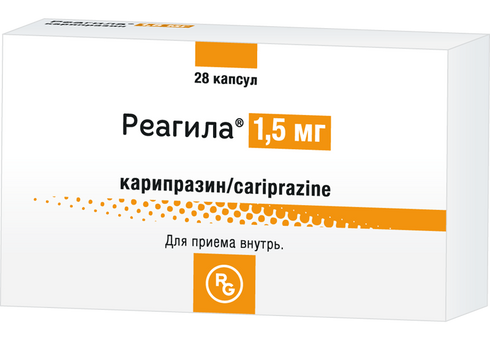
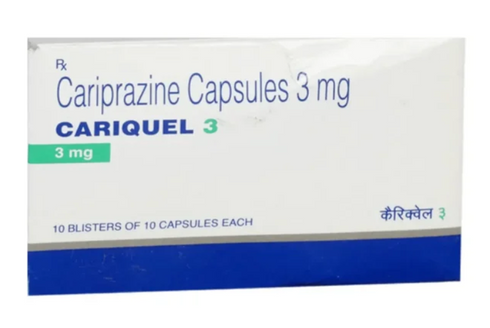
Mechanism
Cariprazine is a partial at and D3 receptors, with a notably higher affinity for D3 than for D2; this D3-preferring profile is what sets it apart from most antipsychotics. As a partial agonist it acts as a stabilizer, tamping down excess dopamine signaling where it is too high (helping psychosis) while providing some tone where dopamine is low, which is thought to spare and even help the negative and cognitive symptoms. It is additionally a partial agonist at receptors (associated with anxiolytic and mood benefits) and an at 5-HT2B receptors. It also has a long-acting active , desmethyl- and didesmethyl-cariprazine, which gives it a very extended duration of action.
receptor fingerprint
5-HT2B receptorAntagonist
D3 receptorPartial agonist (high affinity, D3-preferring)
receptorPartial agonist
receptorPartial agonist
Safetyrisks and cautions, not medical advice
As a real antipsychotic, cariprazine carries meaningful risks. Common effects include akathisia (a distressing inner restlessness), extrapyramidal symptoms (drug-induced stiffness and movement problems), sleep disturbance, and nausea. Like all antipsychotics it carries a warning about increased mortality when used for dementia-related psychosis in older adults, and rare but serious risks include tardive dyskinesia (potentially lasting involuntary movements) and neuroleptic malignant syndrome. Because it and its active metabolites linger in the body for a long time, side effects can appear or build gradually over weeks, and it should be started, changed, or stopped only under medical supervision. Not medical advice.
Interactionsdocumented pairs only, not exhaustive
CYP3A4 inhibitors like ketoconazole significantly increase cariprazine plasma exposure. A strong CYP3A4 inhibitor increases total cariprazine (parent drug plus metabolites) exposure by up to 6-fold at steady state, with dose adjustment requirements updated in November 2024 FDA prescribing information [4]. This is a pharmacokinetic interaction. Moderate CYP3A4 inhibitors produce approximately 2.9-fold increases in exposure. The duration of this interaction is prolonged because cariprazine's major metabolite didesmethyl-cariprazine reaches steady state over 4 to 8 weeks, meaning peak interaction effects may take weeks to manifest and resolve slowly after drug cessation. Commonly used pairings with mild CYP3A4 inhibitors or other antipsychotics lack formal interaction studies.
Checking a whole stack? Run it through interactions + stacks.
Subjective profileweighing the evidence above
A real antipsychotic with a genuinely different shape; the D3 preference is why it reaches negative and cognitive symptoms other agents miss, and also why akathisia is so common. Tardive dyskinesia and neuroleptic malignant syndrome stay rare but real. Prescribed and supervised, full stop.
Where to buy
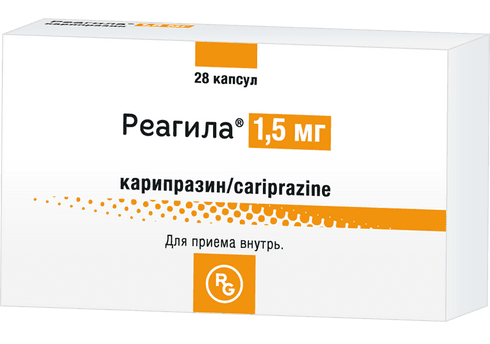
1 other outlet
Suppliers
Vendors carrying Cariprazine, with live product details and codes. Links are affiliate links that support the wiki at no cost to you.
RUPharma🌐
Cariprazine

RUPharma🌐
Cariprazine
Research
- 2021first citedCariprazine, A Broad-Spectrum Antipsychotic for the Treatment of Schizophrenia: Pharmacology, E…
- 2024meta-analysisCariprazine in the acute treatment of unipolar and bipolar depression: A systematic review and…
- 2026most recentCariprazine augmentation for negative symptoms of schizophrenia: a prospective analysis and lit…
- 1.Cariprazine, A Broad-Spectrum Antipsychotic for the Treatment of Schizophrenia: Pharmacology, Efficacy, and Safety
- 2.Cariprazine augmentation for negative symptoms of schizophrenia: a prospective analysis and literature review
- 3.Cariprazine in the acute treatment of unipolar and bipolar depression: A systematic review and meta-analysis
- 4.Physiologically-Based Pharmacokinetic Model-Informed Labeling for Cariprazine Drug Interactions With CYP3A Inhibitors.
4 listed here; entry last updated August 2026
Reviews
My notesprivate to this device
FAQ
What makes cariprazine a third-generation antipsychotic?
It is a dopamine partial agonist rather than a pure blocker, so it stabilizes dopamine toward a middle setpoint instead of only shutting it down. That partial-agonist approach is the hallmark of the third generation.
Why is its D3 preference a big deal?
Most antipsychotics do little at D3. Cariprazine's unusually high D3 affinity is thought to be why it may help the negative and cognitive symptoms of schizophrenia, the parts that older drugs leave largely untouched.
Why do effects take so long to settle?
Cariprazine has long-lived active metabolites, so the drug accumulates and clears slowly. Benefits and side effects can keep building for weeks, which is why dose changes are made gradually and under supervision.
Adverse effects
- Akathisia (inner restlessness)
- Extrapyramidal symptoms (stiffness, tremor, movement problems)
- Insomnia and nausea
- Rare tardive dyskinesia and neuroleptic malignant syndrome