
spec sheet15 rows
Trazodone is an antidepressant of the serotonin antagonist and reuptake inhibitor (SARI) class, used for major depression and very widely, if off-label, as a sleep aid [1][2]. Chemically a phenylpiperazine, it combines blockade of certain serotonin receptors with weak inhibition of serotonin reuptake and sedating actions at histamine and adrenergic receptors [1]. Developed in Italy in the 1960s and approved in the United States in 1981, it is sold under names such as Desyrel and Oleptro.
- Supports fast sleep onset and deeper sleep
- Sedating at histamine and 5-HT2A receptors
- Not a habit forming sleep option
- Carries an anxiety easing angle too
- Decades of clinical use behind it
- Antidepressant pedigree, sleep aid reputation
- Drowsiness is the most common effect, which is why low doses are often used for sleep
- It can lower blood pressure on standing, causing dizziness and, in older adults, a risk of falls
- Priapism, a rare but serious prolonged erection, requires urgent medical care
Overview
Trazodone is a second-generation antidepressant classified as a serotonin antagonist and reuptake inhibitor, a category defined by its combination of serotonin-2 receptor blockade with weaker inhibition of serotonin reuptake [1][2]. Chemically it is a triazolopyridine and a phenylpiperazine derivative, structurally distinct from the older tricyclic antidepressants and the monoamine oxidase inhibitors [1]. It was developed in Italy in the 1960s by the Angelini research laboratories and reached the United States in 1981, where it was the first non-tricyclic, non-MAOI antidepressant to be approved [1].
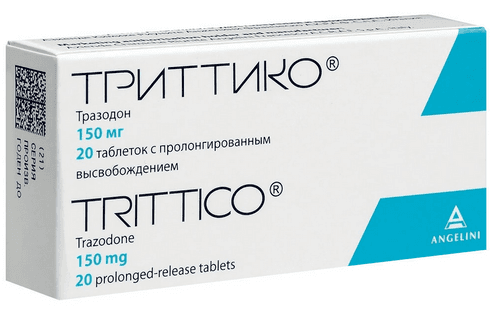
Its labeled indication is major depressive disorder, but in practice trazodone is used most often at lower doses as a sleep aid, an off-label application that has come to exceed its use as an antidepressant [3]. Systematic reviews support its effectiveness for both primary insomnia and insomnia occurring alongside depression or dementia, and it is also used to augment other antidepressants and to help counter the insomnia or sexual side effects sometimes caused by SSRIs [1][3]. Additional off-label uses include anxiety, agitation, and chronic pain [1]. It is available as immediate-release and extended-release tablets, marketed under brand names including Desyrel, Oleptro, and Trittico, and it is widely available as a generic.
Trazodone is metabolized in the liver, chiefly by the enzyme CYP3A4, and one of its metabolites, meta-chlorophenylpiperazine (mCPP), is itself active on serotonin systems [1][2]. Its relatively short half-life and sedating profile suit its use for sleep. Compared with older antidepressants it causes little in the way of anticholinergic effects, weight gain, or sexual dysfunction [2]. The most prominent side effect is drowsiness, and its blockade of alpha-1 adrenergic receptors can cause a drop in blood pressure on standing, raising the risk of dizziness and falls, especially in older adults [1]. A rare but important adverse effect is priapism, a prolonged and painful erection that requires urgent care, and the drug can occasionally affect heart rhythm, including QT-interval prolongation [1].
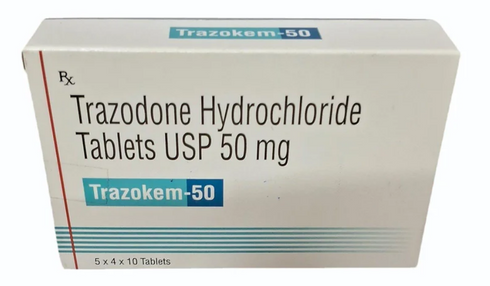
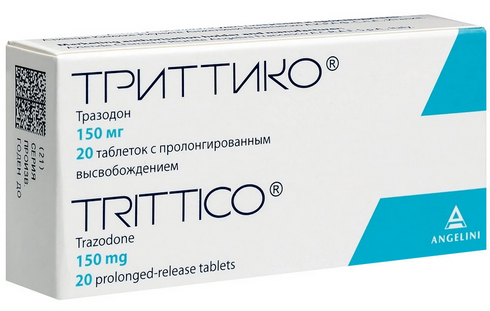
- Trazodone is prescribed far more often for sleep than for depression, yet it has never been formally approved as a hypnotic; that enormous use is entirely off-label.
- The drug is dose-dependent in a striking way, acting mainly as a sedative at low doses and as an antidepressant only at substantially higher ones.
- One of its breakdown products, mCPP, is itself pharmacologically active on serotonin receptors and can contribute to both effects and side effects.
Mechanism
Trazodone acts on several targets at once, and its effects shift with dose, which is why the same drug can treat depression at higher doses and promote sleep at lower ones [1][2]. Its signature action is potent antagonism of the receptor, complemented by weaker blockade of the 5-HT2C receptor and, at higher doses, inhibition of the serotonin transporter that recycles serotonin back into neurons [1][2]. The net result is a rebalancing of signaling that differs from the simple reuptake blockade of SSRIs, and this profile is associated with a lower burden of sexual side effects [2].
Trazodone also blocks H1 receptors and alpha-1 receptors, actions that produce its characteristic sedation and its tendency to lower blood pressure on standing; the antihistamine and effects together account for its usefulness as a hypnotic [1]. It behaves as a partial at the receptor as well [1]. One of its metabolites, meta-chlorophenylpiperazine, is pharmacologically active and interacts with receptors, which can contribute to both effects and side effects [1][2]. Because it is broken down largely by the liver enzyme CYP3A4, drugs that inhibit or induce this enzyme can meaningfully change trazodone levels [2].
receptor fingerprint
receptorantagonist
transporter (SERT)inhibits
H1 / alpha-1 antagonist
partial agonist
Dosingtypical ranges, not medical advice
interested in protocols and clinical dosages? make an account to see them! ^_^
Safetyrisks and cautions, not medical advice
Trazodone is a serotonergic antidepressant widely used off-label at low doses for sleep; common effects are sedation, next-day drowsiness, dizziness, dry mouth, and orthostatic hypotension with a fall risk, especially in older adults. It can rarely cause priapism, a urologic emergency, along with QT-interval prolongation and serotonin syndrome when combined with other serotonergic agents. It carries the antidepressant class warning for suicidal thinking in younger patients and should not be combined with MAO inhibitors.
Interactionsdocumented pairs only, not exhaustive
Trazodone is a serotonergic agent and its label contraindicates concurrent or recent (within 14 days) monoamine oxidase inhibitors, and warns of serotonin syndrome when combined with SSRIs, SNRIs, triptans, tramadol, linezolid or other serotonergic drugs. It is primarily metabolized by CYP3A4, so strong CYP3A4 inhibitors (ketoconazole, ritonavir, itraconazole, clarithromycin, grapefruit) raise trazodone and mCPP levels and increase toxicity risk, while CYP3A4 inducers such as carbamazepine lower its exposure. Trazodone prolongs the QT interval, giving additive arrhythmia risk with other QT-prolonging drugs, and its sedative and alpha-1 blocking actions produce additive CNS depression with alcohol, benzodiazepines and opioids plus additive hypotension with antihypertensives. It can also raise plasma digoxin and phenytoin concentrations. This is research information, not medical advice.
Checking a whole stack? Run it through interactions + stacks.
History
Trazodone was developed in Italy by the research laboratories of Angelini Francesco during the 1960s, emerging from a distinctive line of thinking about depression as a disorder linked to lowered tolerance of mental pain. A phenylpiperazine compound, it was the first of the serotonin antagonist and reuptake inhibitor, or SARI, class, combining blockade of certain serotonin receptors with weak inhibition of serotonin reuptake and sedating actions at histamine and adrenergic receptors.
After establishing itself in Europe, it was approved in the United States in 1981, where it held the distinction of being one of the first widely used antidepressants that was neither a tricyclic nor a monoamine oxidase inhibitor. Although marketed for depression under names such as Desyrel and, in an extended-release form, Oleptro, it found its largest real-world use off-label as a sleep aid, a role built on its pronounced sedating properties at low doses. It remains among the most commonly prescribed medications for insomnia in many countries.
Reputation
Trazodone is widely appreciated as a versatile and pragmatic medicine, best known today as a low-dose sleep aid that many clinicians favor because it is not a controlled substance and carries little risk of dependence. Its appeal for insomnia rests on its sedating blockade of histamine and serotonin 5-HT2A receptors, which can help people fall and stay asleep without the tolerance concerns associated with some hypnotics.
At higher, antidepressant doses it offers a receptor profile distinct from the SSRIs, and it is often noted for a comparatively low burden of sexual side effects, a meaningful advantage for some patients. Candor requires mentioning its trade-offs, including morning grogginess, dizziness on standing from its blood-pressure-lowering action, and a rare but well-recognized risk of prolonged erections that warrants prompt attention. Taken together, its flexibility, favorable dependence profile, and long track record keep it a trusted and frequently chosen option.
Subjective profileweighing the evidence above
One of the more sensible prescription sleep options, because it does not build dependence the way the hypnotics do and a low dose is usually enough. The tradeoffs are morning grogginess and blood pressure dips on standing, which matter most in older adults; priapism is rare but an emergency.
Where to buy

Suppliers
Vendors carrying Trazodone, with live product details and codes. Links are affiliate links that support the wiki at no cost to you.
PCT.Zone
Trazodone
RUPharma🌐
Trazodone
RUPharma🌐
Trazodone
Research
- 1983first citedTrazodone and priapism
- 2018most active year4 papers
- 2026most recentThe efficacy and safety of trazodone for sleep problems in depressive patients: a GRADE-assesse…
- 1.Trazodone: properties and utility in multiple disorders.
- 2.Clinical guidance for the use of trazodone in major depressive disorder and concomitant conditions: pharmacology and clinical practice.
- 3.Trazodone for Insomnia: A Systematic Review.
- 4.Trazodone for the treatment of insomnia: a meta-analysis of randomized placebo-controlled trials
- 5.Effects of Trazodone on Sleep: A Systematic Review and Meta-analysis
- 6.Antidepressants for insomnia in adults
- 7.Comparative effects of pharmacological interventions for the acute and long-term management of insomnia disorder in adults: a systematic review and network meta-analysis
- 8.Pharmacotherapies for sleep disturbances in dementia
- 9.Review of Safety and Efficacy of Sleep Medicines in Older Adults
- 10.Pharmacotherapy for sleep disturbances in post-traumatic stress disorder (PTSD): A network meta-analysis
- 11.Effect of trazodone versus cognitive-behavioural treatment on high- and slow-frequency activity during non-rapid eye movement sleep in chronic insomnia: A pilot, randomized clinical trial
- 12.The use of trazodone as a hypnotic: a critical review
22 listed here; entry last updated August 2026
Reviews
My notesprivate to this device
FAQ
What is trazodone?
It is an older antidepressant that is now more commonly used at low levels as a sleep aid.
How does it promote sleep?
It blocks certain serotonin and histamine receptors, which produces a sedating effect.
Is it habit-forming?
It is generally considered non-habit-forming, which is one reason it is used for sleep.
Why might it cause morning grogginess?
Its sedating effects can linger into the morning for some people depending on individual metabolism.
Adverse effects
- Drowsiness is the most common effect, which is why low doses are often used for sleep
- It can lower blood pressure on standing, causing dizziness and, in older adults, a risk of falls
- Priapism, a rare but serious prolonged erection, requires urgent medical care
- It has little anticholinergic effect and is less likely than some antidepressants to cause weight gain or sexual side effects
Notes and cautions
- It can occasionally affect heart rhythm, including QT-interval prolongation