
spec sheet13 rows
Montelukast is a leukotriene receptor antagonist, an anti-inflammatory drug taken by mouth to help control asthma and to relieve allergic rhinitis. It works by blocking cysteinyl leukotrienes, inflammatory signaling molecules that constrict the airways and drive allergic reactions. Sold under the brand name Singulair and approved in the United States in 1998, it is widely prescribed but carries a boxed warning about the risk of serious mood and behavior changes.
- One tablet a day keeps asthma symptoms in check
- Blocks the leukotrienes that tighten airways
- Stops exercise triggered wheeze before it starts
- Clears the sneezing and congestion of hay fever
- A steroid free controller; nothing to inhale
- Strong add on when an inhaler alone is not enough
- Headache
- Abdominal pain or stomach upset
- Neuropsychiatric effects such as nightmares, insomnia, anxiety, low mood, or irritability (subject of a boxed warning)
Overview
Montelukast is an oral anti-inflammatory medicine of the class known as leukotriene receptor antagonists, sometimes called leukotriene-modifying agents. It specifically blocks the cysteinyl leukotriene receptor, interrupting a chemical signaling pathway that contributes to asthma and allergic disease [1].
The drug was approved by United States regulators in 1998 and marketed as Singulair; it became available as a generic after 2012 and is now one of the more commonly prescribed medicines in the United States [1]. It is taken by mouth and is formulated as standard tablets, chewable tablets and oral granules, the last making it convenient for young children [1].
Montelukast is used mainly for the long-term, maintenance control of asthma, although treatment guidelines generally place it below inhaled corticosteroids as a preventer; it does not relieve an asthma attack once one has begun. It is also used for allergic rhinitis (hay fever) and to prevent exercise-induced narrowing of the airways [1]. Following safety concerns, regulators have advised reserving montelukast for allergic rhinitis only when other treatments are inadequate or not tolerated [1].
The most prominent safety issue is neuropsychiatric. Reports of mood and behavior changes led the United States Food and Drug Administration to add a boxed warning in 2020, its strongest form of caution, listing effects such as nightmares, insomnia, depression, anxiety and agitation [1]. Systematic reviews of the evidence have reached mixed conclusions: several found no clear link with suicide or depression, while others detected possible associations with anxiety and sleep disturbances, particularly in certain age groups, and reviews in children likewise report predominantly gastrointestinal and neuropsychiatric adverse effects [2][3][4]. The overall risk remains difficult to quantify, and careful monitoring is advised [3].

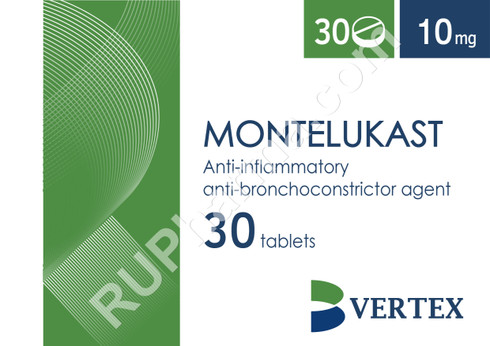
- Montelukast is taken as a single daily tablet, a convenience that made it especially popular for children and for people who dislike inhalers.
- In 2020 the FDA placed a boxed warning on montelukast over reports of serious mood and behavior changes, prompting closer attention to its neuropsychiatric effects.
- Unlike an inhaler, montelukast does nothing to relieve an asthma attack in progress; its benefit comes from steadily suppressing leukotriene-driven inflammation over time.
Mechanism
Montelukast targets the cysteinyl leukotrienes, a group of inflammatory lipid mediators (leukotrienes C4, D4 and E4) that are released by mast cells and eosinophils during allergic and asthmatic responses. These leukotrienes act on the cysteinyl leukotriene type 1 (CysLT1) receptor to constrict airway smooth muscle, increase mucus secretion, promote fluid leakage and swelling in the airway wall and draw in more inflammatory cells [1].
By selectively binding and blocking the CysLT1 receptor, montelukast prevents leukotrienes from producing these effects, which reduces airway inflammation and bronchoconstriction and eases allergic symptoms [1]. Unlike bronchodilators, it does not act directly to open constricted airways during an attack; its benefit builds through ongoing suppression of leukotriene-driven inflammation. Investigations into its neuropsychiatric effects have reported that the drug can bind to a number of receptors in the brain, a finding being studied as a possible explanation for the mood and behavior changes seen in some users [1].
receptor fingerprint
Cysteinyl leukotriene receptor 1 (CysLT1)antagonist
Leukotriene D4 signalingblocks
Airway smooth musclemodulates
Eosinophil recruitmentblocks
Vascular permeabilitymodulates
Dosingtypical ranges, not medical advice
interested in protocols and clinical dosages? make an account to see them! ^_^
Safetyrisks and cautions, not medical advice
Montelukast is a prescription medicine that is generally well tolerated, with headache and abdominal pain among the most common effects. Its most important concern is a range of neuropsychiatric effects, including mood changes, agitation, sleep disturbance, vivid dreams and rarely suicidal thoughts, which prompted a boxed warning. Rarely, reducing oral steroids while on it can unmask an eosinophilic condition affecting blood vessels. It should not be relied on for acute attacks.
Interactionsdocumented pairs only, not exhaustive
Montelukast has fewer clinically important interactions than most respiratory drugs, and those that exist run largely in one direction: other drugs changing montelukast exposure rather than the reverse.
Montelukast is cleared mainly by CYP2C8, with CYP3A4 and CYP2C9 contributing. Gemfibrozil, a strong CYP2C8 inhibitor, raises montelukast AUC about 4.5-fold and triples its half-life, mostly because gemfibrozil's glucuronide metabolite blocks formation of the M6 metabolite. Strong enzyme inducers work the other way; phenobarbital cuts montelukast AUC by roughly 40%, and rifampin is expected to behave similarly. That shows up as loss of asthma control rather than as a side effect, which makes it easy to miss.
Montelukast is itself a potent CYP2C8 inhibitor in liver microsomes, but this has not translated into meaningful inhibition at ordinary doses in people.
Nothing in the interaction profile speaks to the neuropsychiatric adverse effects montelukast carries a boxed warning for; those appear independent of other medication.
Checking a whole stack? Run it through interactions + stacks.
History
Montelukast was discovered and developed by Merck (Merck Frosst) in Canada during the 1990s as an orally active, once-daily antagonist of the cysteinyl leukotriene receptor. It arose from a broad effort to translate the newly understood biology of the leukotrienes, inflammatory mediators of asthma, into a convenient pill. It received US FDA approval in 1998 under the brand name Singulair for asthma, with allergic rhinitis indications following. As a well-tolerated tablet suitable for children and adults, it became one of the best-selling respiratory medicines of its era, and generic versions appeared after the patent expired around 2012. In 2020 the FDA added a boxed warning about the risk of serious neuropsychiatric events, a development that has since shaped prescribing.
Reputation
Montelukast is widely valued for its convenience and gentleness on the airways; a single daily tablet that helps control asthma and calm allergic rhinitis without the technique demands of an inhaler or the concerns of oral steroids. It has been especially popular in children and in people whose asthma is closely tied to allergies or exercise, and a 2024 meta-analysis found that combining it with an antihistamine improved nasal symptoms more than antihistamine alone. Its once-daily oral dosing and long clinical track record are genuine strengths. In fairness, it is not a rescue medicine and does not open constricted airways during an attack, and the 2020 boxed warning about mood and behavior changes has appropriately made prescribers more cautious. For the right patient, monitored sensibly, it remains a useful and well-established controller.
Subjective profileweighing the evidence above
A genuinely useful once-daily prescription controller for asthma and allergic rhinitis, but the neuropsychiatric boxed warning deserves real weight: nightmares, low mood, agitation and rarely suicidal thoughts, especially in children. Anyone on it should know to watch for mood and behavior changes.
Where to buy

1 other outlet

Suppliers
Vendors carrying Montelukast, with live product details and codes. Links are affiliate links that support the wiki at no cost to you.
PCT.Zone
Montelukast
RUPharma🌐
Montelukast
Research
- 2018first citedNeuropsychiatric Events Associated with Leukotriene-Modifying Agents: A Systematic Review.
- 2025most recentEfficacy and safety of montelukast-levocetirizine combination therapy in combined allergic rhin…
- 1.A Boxed Warning for Montelukast: The FDA Perspective.
- 2.Neuropsychiatric events associated with montelukast in patients with asthma: a systematic review.
- 3.Neuropsychiatric Events Associated with Leukotriene-Modifying Agents: A Systematic Review.
- 4.Adverse drug reactions of leukotriene receptor antagonists in children with asthma: a systematic review.
- 5.Efficacy and safety of montelukast-levocetirizine combination therapy in combined allergic rhinitis and asthma syndrome: a systematic review and meta-analysis
5 listed here; entry last updated August 2026
Reviews
My notesprivate to this device
FAQ
Can I use montelukast for an asthma attack?
No. It prevents symptoms over time and does not open the airways quickly, so you still need a rescue inhaler for attacks.
Why take it in the evening?
Nighttime and early morning asthma symptoms are common, and evening dosing matches the drug to that pattern.
What are the mood warnings about?
Regulators added a boxed warning because some people develop mood changes, agitation, sleep problems or suicidal thoughts; report these right away.
Does it help hay fever too?
Yes, it is approved for allergic rhinitis and can ease nasal allergy symptoms, though antihistamines are often tried first.
How soon does it work?
Airway effects can begin within a day, but the full benefit for control builds over regular daily use.
Adverse effects
- Headache
- Abdominal pain or stomach upset
- Neuropsychiatric effects such as nightmares, insomnia, anxiety, low mood, or irritability (subject of a boxed warning)
- Cough or upper respiratory symptoms
- Rarely, agitation or behavior changes, especially in children