
spec sheet10 rows
ISRIB is an experimental laboratory compound that switches off a cellular alarm system called the integrated stress response; that alarm normally slows a cell's protein production when the cell is under strain. It works by clamping a protein machine called eIF2B into its active shape, which lets brain cells resume making the new proteins that forming a memory depends on. In mice and rats it speeds learning, restores memory weeks after a head injury, and reverses some age-related memory loss, at doses well under a milligram per kilogram. All of that evidence comes from cells and rodents; ISRIB has never been given to a person in a registered clinical trial, so there is no human dose, no human safety record, and no evidence it does anything in people.
- Releases the cellular stress brake
- Reversed memory deficits in rodent studies
- Restarts the protein building that memory needs
- Studied for cognitive recovery after head injury
- Explored against age related mental decline
- A genuine deep cut for neuroprotection
- It appears to act only during low-level stress, which may limit off-target effects
Overview
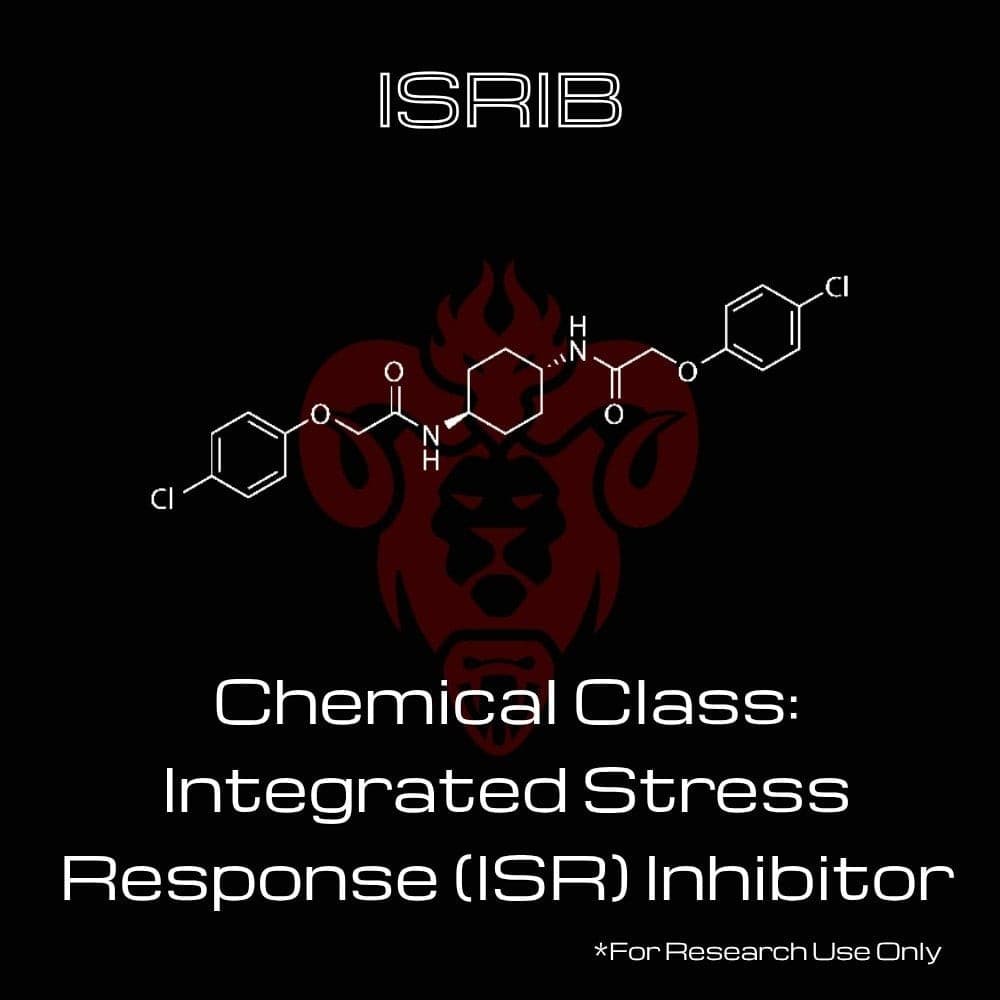
ISRIB, short for integrated stress response inhibitor, is a synthetic, drug-like small molecule discovered in 2013 by a team at the University of California, San Francisco. It emerged from a cell-based screen for inhibitors of PERK signaling, one arm of a network of stress pathways collectively known as the integrated stress response (ISR) [1]. Chemically it is a symmetric bis-glycolamide, and it is notable for being one of the first molecules able to switch off the ISR pharmacologically.
The integrated stress response is a conserved cellular program: in response to stresses such as viral infection, endoplasmic reticulum stress, or nutrient deprivation, one of several kinases (PERK, PKR, GCN2, or HRI) phosphorylates the alpha subunit of translation initiation factor eIF2. This phosphorylation converts eIF2 from a substrate into a competitive inhibitor of eIF2B, its guanine nucleotide exchange factor, which broadly dampens protein synthesis while allowing preferential translation of certain stress mRNAs. ISRIB targets eIF2B directly and reverses these effects, restoring translation even when eIF2 is phosphorylated [1][2]. Structural studies using cryo-electron microscopy showed that ISRIB binds in a deep cleft at the center of the decameric eIF2B complex, acting as a molecular staple that cross-bridges two tetrameric halves to stabilize the fully active enzyme [3][5].
Because eIF2 phosphorylation limits memory consolidation, releasing this brake has striking cognitive effects: ISRIB-treated mice show enhanced spatial and fear-associated learning, and the molecule corrects cognitive deficits after traumatic brain injury and in models of neurodegeneration and Alzheimer's-related amyloid toxicity [1][3][6]. A distinctive safety-relevant feature is that ISRIB only suppresses low-level ISR activation and loses effect once eIF2 phosphorylation exceeds a threshold, which may explain its lack of overt toxicity in animals [4]. ISRIB is an investigational research compound and is not an approved medicine.
- ISRIB works as a molecular staple, physically clamping two halves of the eIF2B enzyme together to keep it in its active, ten-subunit form.
- It is remarkably potent, blocking the integrated stress response in cells with a half-maximal concentration of about 5 nanomolar.
Mechanism
ISRIB works by reactivating eIF2B, the enzyme at the heart of the integrated stress response. Under stress, kinases such as PERK phosphorylate the alpha subunit of eIF2; the phosphorylated form (P-eIF2) becomes a competitive inhibitor of eIF2B, the guanine nucleotide exchange factor that recycles inactive eIF2-GDP into active eIF2-GTP. With eIF2B inhibited, general protein synthesis falls and the cell shifts into a stress-adapted translational program. ISRIB reverses this by binding eIF2B and boosting its exchange activity, so translation resumes even in the presence of P-eIF2; in the original screen it did so potently, with a half-maximal inhibitory concentration of about 5 nM against the ISR [1].
The molecular details were resolved by structural work. Genetic screens first mapped ISRIB's target to the delta subunit of eIF2B, and cryo-electron microscopy then showed ISRIB bound in a deep central cleft of the decameric eIF2B holoenzyme [2][3]. There it functions as a molecular staple: it cross-bridges a symmetry interface, promoting the assembly of two eIF2B tetramers into the fully active decamer, effectively acting as a rheostat that tunes eIF2B activity [3][5]. This same stapling can rescue certain loss-of-function eIF2B mutations that cause disease [5].
The functional benefits flow from restored, less-stress-limited translation in the brain. Because eIF2 phosphorylation normally caps memory consolidation, ISRIB releases that limit and enhances spatial and fear-associated learning in healthy mice, while correcting cognitive deficits after traumatic brain injury [1][3]. In a rat model of Alzheimer's-related amyloid-beta toxicity, ISRIB prevented amyloid-facilitated long-term depression, normalized hippocampal protein synthesis, and abrogated spatial memory deficits [6]. Importantly, ISRIB acts only within a defined window: once P-eIF2 rises above a critical threshold it becomes ineffective, sparing the protective acute stress response and likely accounting for its clean tolerability in animal studies [4].
receptor fingerprint
eIF2B (integrated stress response)activates (ISR inhibitor)
eIF2-alpha phosphorylation blockreverses
Age-related memory declinereverses
eIF2B decamer, beta/delta regulatory interface (EIF2B2 / EIF2B4)Activator. One symmetric ISRIB molecule binds a deep cleft straddling the two-fold symmetry axis between the beta and delta subunits, engaging the same residues from both protomers.
eIF2B holoenzyme assembly (beta-gamma-delta-epsilon tetramer to active decamer)Promotes assembly and stabilises the assembled complex; acts as a molecular staple cross-bridging two identical tetrameric subcomplexes.
eIF2B guanine nucleotide exchange activity toward eIF2Enhances. Restores eIF2-GDP to eIF2-GTP recycling so cap-dependent translation resumes despite phosphorylated eIF2-alpha.
Phosphorylated eIF2-alpha regulatory site on eIF2B (alpha/delta cleft)Allosteric antagonism. ISRIB does not bind eIF2-alpha-P; the two ligands reciprocally oppose each other's binding to eIF2B, so ISRIB loses grip as stress rises.
ATF4 and CHOP translational output of the integrated stress responseSuppresses induction downstream of eIF2-alpha phosphorylation; this is the readout ISRIB was screened on.
PERK, PKR, GCN2, HRI and eIF2-alpha Ser51 phosphorylationNOT a target. ISRIB was found in a PERK-signalling screen but does not inhibit these kinases and does not lower eIF2-alpha phosphorylation; it acts entirely downstream at eIF2B.
Classical receptors, transporters and enzymesNo published activity. No off-target selectivity panel for ISRIB was located.
Dosingtypical ranges, not medical advice
interested in protocols and clinical dosages? make an account to see them! ^_^
Safetyrisks and cautions, not medical advice
Human safety: entirely unknown. Zero human exposures on record, no adverse-event data, no maximum tolerated dose, no drug-interaction data, no reproductive, genotoxicity or carcinogenicity testing, and no published toxicology package of any kind for ISRIB.
Animal safety: thin and short-term. Sidrauski 2013 (PMID 23741617) reported "no overt toxicity" in mice over the brief courses used, and later behavioural papers do not report tolerability outcomes at all; Chou 2017 (PMID 28696288), for instance, reports no weight, toxicity or side-effect data. No chronic-dosing study of ISRIB in any species was found. "No overt toxicity over three injections in a mouse" is not a safety record.
Mechanism-based hazards that are actually documented, not speculative: 1. The integrated stress response is protective. Sidrauski 2013 showed ISRIB reduces the viability of cells undergoing PERK activation by chronic ER stress, and that unmitigated ER stress synergises with ISRIB to drive apoptosis. Suppressing an adaptive alarm is the core risk of this whole drug class. 2. ISRIB is self-limiting, which cuts both ways. Rabouw 2019 (PMID 30674674) showed ISRIB cannot suppress the ISR once phosphorylated eIF2-alpha rises above a threshold; the authors propose this is exactly why ISRIB does not produce overt toxicity in vivo. The same property caps how much it can ever do. 3. Direction of effect in cancer cells is context dependent, not uniformly benign: ISRIB protected multiple myeloma cells from bortezomib-induced apoptosis while sensitising breast cancer cells to it (PMID 35114585). 4. Theoretical and untested in humans: the ISR is part of antiviral and innate immune defence and of pancreatic beta-cell adaptation, so long-term suppression is a plausible risk that no study has addressed.
Interactions: none characterised. No CYP, transporter or clinical drug-drug interaction data exists for ISRIB.
Regulatory status: not approved by any regulator, anywhere, for any indication, in any species. ISRIB is sold only as a "research use only, not for human consumption" laboratory reagent (Cayman Chemical, Sigma-Aldrich, Santa Cruz Biotechnology and others; CAS 1597403-47-8), and it circulates in the nootropics community through grey-market group buys. It is not a scheduled controlled substance in the US.
WADA: ISRIB is not named on the WADA Prohibited List. It falls squarely inside the S0 "Non-Approved Substances" definition, which prohibits at all times any pharmacological substance not currently approved by any governmental regulatory health authority for human therapeutic use. An athlete should treat ISRIB as banned in and out of competition.
Bearing on the mechanism, though not on ISRIB itself: the two eIF2B activators that did reach humans have not delivered. Denali's DNL343 missed the primary endpoint and showed no neurofilament-light effect in HEALEY ALS Regimen G, and the extension was discontinued in March 2025, although the drug was reported safe and well tolerated. AbbVie/Calico's fosigotifator (ABBV-CLS-7262) has a Phase 1 ALS study and a Phase 1b major depressive disorder study both listed as TERMINATED on ClinicalTrials.gov, with vanishing white matter disease trials still running.
History
ISRIB was discovered in 2013 at the University of California, San Francisco in the laboratory of Peter Walter, identified in a phenotypic screen for small molecules that block the integrated stress response. Its molecular target was subsequently mapped to eIF2B, and cryo-electron microscopy revealed that it binds within the central cleft of the eIF2B decamer, acting as a molecular staple that stabilizes the active enzyme. Since its discovery it has become one of the most studied experimental neuroprotective and memory-enhancing molecules, with reports of enhanced cognition in healthy mice and correction of deficits after traumatic brain injury. It remains a research compound, and it has inspired clinical-stage derivatives.
Reputation
ISRIB is widely celebrated in neuroscience as a proof of concept that a single small molecule can lift a brake on protein synthesis and, in doing so, sharpen memory in animals. It is admired for its precision; it reactivates eIF2B only below a threshold of stress, leaving the protective acute stress response intact, which likely explains its clean tolerability in rodent studies. Findings that it can reverse traumatic brain injury deficits and normalize memory in Alzheimer's models have kept it at the frontier of cognitive-aging research. In honest terms, the human evidence is not yet established, and its benefits have been demonstrated primarily in mice and rats.
Subjective profileweighing the evidence above
One of the most interesting cognition compounds in the preclinical literature, with real memory restoration in rodents after injury and ageing. It is still only that: no human safety record, poor solubility making doses inconsistent, and a fair worry about switching off a stress response that exists for a reason.
Where to buy
1 other outlet
Suppliers
Vendors carrying ISRIB, with live product details and codes. Links are affiliate links that support the wiki at no cost to you.
Kimera Chems
ISRIB
Limitless Biochem🌐
ISRIB
Research
- 2013first citedPharmacological brake-release of mRNA translation enhances cognitive memory.
- 2025most active year7 papers
- 2026most recentISRIB as a prototype eIF2B activator: Pharmacology, mechanisms, and translational potential in…
- 1.Pharmacological brake-release of mRNA translation enhances cognitive memory.
- 2.Stress responses. Mutations in a translation initiation factor identify the target of a memory-enhancing compound.
- 3.Structure of the nucleotide exchange factor eIF2B reveals mechanism of memory-enhancing molecule.
- 4.Small molecule ISRIB suppresses the integrated stress response within a defined window of activation.
- 5.Structural insights into ISRIB, a memory-enhancing inhibitor of the integrated stress response.
- 6.Inhibition of the ISR abrogates mGluR5-dependent long-term depression and spatial memory deficits in a rat model of Alzheimer's disease.
- 7.The integrated stress response: From mechanism to disease.
- 8.ISRIB Blunts the Integrated Stress Response by Allosterically Antagonising the Inhibitory Effect of Phosphorylated eIF2 on eIF2B.
- 9.Targeting the integrated stress response with ISRIB enhances CREB/BDNF signaling and attenuates cognitive deficits in a rat model of vascular cognitive impairment.
- 10.Integrated Stress Response Inhibitor Reverses Sex-Dependent Behavioral and Cell-Specific Deficits after Mild Repetitive Head Trauma.
- 11.Restoring glucose metabolism in Alzheimer's disease by targeting integrated stress response.
- 12.PERK inhibitor (ISRIB) improves depression-like behavior by inhibitions of HPA-axis over-activation in mice exposed to chronic restraint stress.
29 listed here; entry last updated August 2026
Reviews
My notesprivate to this device
FAQ
What is the integrated stress response?
It's a cellular pathway that slows protein production under stress. ISRIB is described as releasing that brake.
What did rodent studies show?
Some studies reported restored memory in aged or injured animals. These are striking but preclinical findings.
Is it available as a medicine?
No, it's an investigational research compound. Human data are very limited.
Why is solubility mentioned?
ISRIB has notably poor water solubility, which complicates formulation. Researchers have worked on analogs to address this.
Limitations of the evidence
- Long-term consequences of altering the stress response are not established
Adverse effects
- It appears to act only during low-level stress, which may limit off-target effects
Notes and cautions
- An investigational research compound with no approved human use
- Human safety data are essentially absent; most evidence is from animals
- Poor water solubility has historically complicated its formulation