
spec sheet12 rows
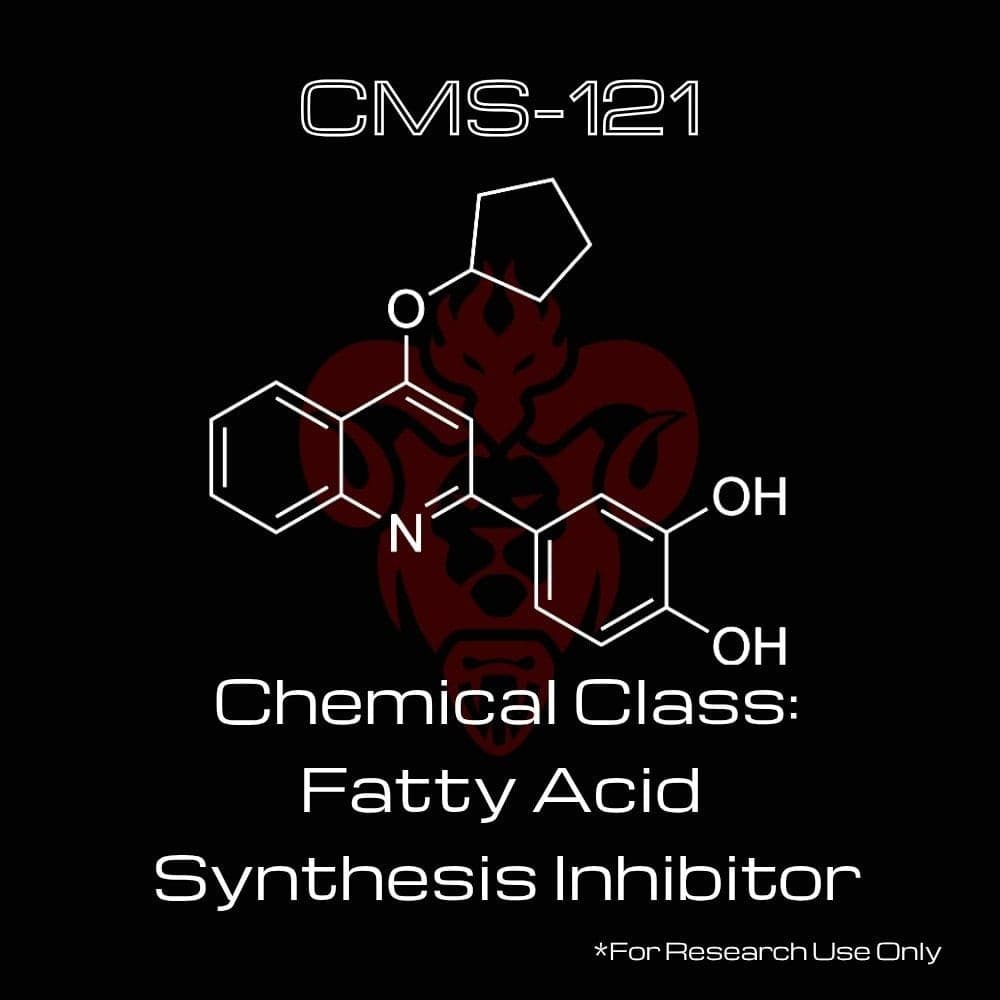
CMS-121 is an experimental drug created by chemically redesigning fisetin, a plant flavonoid; the result is a synthetic quinoline rather than a flavonoid itself, and it is not the same substance as fisetin. In animals it blocks fatty acid synthase, an enzyme that builds fats, and this reduces oxidative damage to the fats in cell membranes; treated mice held onto memory better in models of Alzheimer's disease, Huntington's disease and accelerated ageing, and also showed improved blood sugar and body weight. Human evidence is limited to a single Phase 1 study in 99 healthy volunteers that asked only whether the drug was tolerated and how the body handled it, not whether it helps anyone; that report remains an unpublished preprint. Almost all of the animal work comes from the one laboratory that invented the compound, no human being has ever been tested for a benefit, and CMS-121 is not approved anywhere for any use.
- Fisetin redesigned; stronger and brain penetrant
- Held memory in aging and Alzheimer's models
- Cuts lipid damage inside brain tissue
- Lowers neuroinflammation markers in animals
- Targets fatty acid synthase to slow brain aging
- Tested in a phase 1 human study
Overview
CMS-121 is a synthetic small molecule of the flavonoid class, developed as a neuroprotective drug candidate for Alzheimer's disease and other age-associated neurodegenerative conditions [1]. Chemically it is a derivative of fisetin, a naturally occurring flavonol found in strawberries and other plants that shows antioxidant, anti-inflammatory, and geroprotective activity but suffers from poor metabolic stability. Researchers at the Salk Institute for Biological Studies systematically modified the fisetin scaffold to improve its drug-like properties, generating a library of roughly 160 synthetic derivatives, from which CMS-121 was selected for its potency and favorable pharmacology [3].
The compound emerged from a cell-based phenotypic screening strategy built to protect against oxytosis and ferroptosis, a non-apoptotic regulated cell death pathway increasingly linked to aging and dementia [1]. Rather than aiming at a single classical Alzheimer's target such as amyloid beta, CMS-121 was optimized around age-related changes in brain physiology, an approach its developers describe as addressing the biology of aging itself [2]. In preclinical work it has been evaluated in transgenic and rapidly aging mouse models of Alzheimer's disease, in models of Huntington's disease, and in the setting of the metabolic complications of diabetes [1][2][3].
CMS-121 is an investigational agent and is not an approved drug; it is used in laboratory and preclinical research, and toxicology testing supported an Investigational New Drug clearance that opened the path toward human trials [1]. Beyond neuroscience, the same molecule is employed in cell biology as a pharmacological inhibitor of acetyl-CoA carboxylase 1, where it serves as a research tool to probe fatty acid synthesis and lipid metabolism [4][5]. It is supplied as a research chemical in solid or solution form and is not marketed as a dietary supplement.
- CMS-121 was chosen as a single lead from a library of roughly 160 synthetic derivatives of the plant flavonol fisetin.
- It works in part by raising cellular acetyl-CoA and increasing acetylation of histone H3 at lysine 9, an epigenetic mark tied to memory-supporting gene expression.
- Its specificity is well enough established that other research groups now use CMS-121 as a standard ACC1 inhibitor in studies of fatty liver disease and diabetic blood-vessel dysfunction.
Mechanism
The therapeutic rationale for CMS-121 centers on rescuing the brain from the metabolic and oxidative decline that accompanies aging. Across multiple preclinical models the compound preserved learning and memory, reduced markers of , and limited lipid peroxidation, the self-propagating oxidative damage to membrane fats that characterizes the oxytosis and ferroptosis cell death pathway [1]. In rapidly aging SAMP8 mice it slowed cognitive, metabolic, and transcriptional signs of brain aging, and in Huntington's disease models it improved motor function and extended median lifespan [2][3].
Mechanistically, CMS-121 acts on fatty acid synthase and, more specifically, on acetyl-CoA carboxylase 1 (ACC1), the rate-limiting enzyme of de novo fatty acid synthesis [1][2]. By inhibiting ACC1, the compound raises intracellular levels of acetyl-coenzyme A, the central metabolic currency that links sugar, fat, and protein metabolism to energy production [2]. Elevated acetyl-CoA in turn preserves homeostasis and increases acetylation of histone H3 at lysine 9 (H3K9), an epigenetic mark tied to memory-supporting gene expression [2]. This ACC1-inhibiting activity is defined well enough that independent laboratories now use CMS-121 as a specific pharmacological ACC1 inhibitor in studies of diabetic blood vessel dysfunction and fatty liver disease, where it lowers intracellular free fatty acid and triglyceride levels [4][5].
The molecule's pedigree is itself a quantitative story: CMS-121 was chosen as a single lead from a set of about 160 synthetic fisetin derivatives, prioritized for potency, brain penetration, and efficacy in animal models of Alzheimer's disease [3]. Because it engages a metabolic node shared between normal brain aging and neurodegeneration rather than one disease-specific protein, its developers position it as a broad geroprotective strategy, with benefits spanning memory, function, and cellular resistance to [1][2].
receptor fingerprint
Fatty acid synthase (FASN)Inhibits, reducing excess lipid peroxidation
Acetyl-CoA carboxylase 1 (ACC1)Inhibits, raising acetyl-CoA levels
Acetyl-CoA carboxylase 1 (ACC1 / ACACA)Indirect inhibition via AMPK-mediated phosphorylation at Ser79, not direct binding
Activation; required upstream node for the ACC1 arm
Oxytosis / ferroptosis cell death pathwayInhibition (phenotypic; this pathway was the screening assay the compound was selected on)
Lipid peroxidation and 4-hydroxynonenal adductsReduction (downstream consequence of FASN inhibition)
15-lipoxygenase-2 (ALOX15B)Reduces protein levels; direct binding not demonstrated
Nrf2No induction (negative finding worth recording)
Direct free-radical scavengingWeak; largely absent as a mechanism
Neuroinflammatory signalingDampens inflammatory markers in aging brain tissue
Dosingtypical ranges, not medical advice
interested in protocols and clinical dosages? make an account to see them! ^_^
Safetyrisks and cautions, not medical advice
Regulatory status: CMS-121 is an unapproved investigational drug. It holds an FDA IND, which is permission to run trials, not any form of approval. It is not approved by the FDA, EMA or any other regulator, for any indication, in any country. It has completed Phase 1 only; as of mid-2026 it has not entered Phase 2, and long-term toxicology is still running under NIA funding (grants R44AG085775 and U01AG084549 to Virogenics). It is not a controlled or scheduled substance. It is sold only as a laboratory research reagent (CAS 1353224-53-9, UNII BW9P9F8JEY), not as a supplement, and it is not intended or labelled for human consumption.
WADA: CMS-121 is not named individually on the Prohibited List; as a pharmacological substance with no regulatory approval for human therapeutic use it would fall under category S0, non-approved substances, which is prohibited at all times in and out of competition. Athletes should treat it as banned. Known adverse effects: the Phase 1 reported that the majority of treatment-emergent adverse events were mild in severity and that single doses to 1800 mg and 7 days at 900 mg/day were generally well tolerated.
Beyond that sentence the safety picture is genuinely unknown. No individual adverse event, no frequency table, no maximum tolerated dose and no QTc number could be retrieved: ClinicalTrials.gov has no results posted for NCT05318040, the preprint full text is not in PubMed Central and medRxiv blocks automated retrieval. Cardiac monitoring was clearly a concern to the investigators, since the trial excluded anyone with QT-prolongation risk factors and made QTc a secondary endpoint, and the preprint title flags cardiodynamics; the actual finding is not publicly readable.
Interactions: none have been studied. The trial barred all CYP and P-glycoprotein inducers including St John's wort, all QT-prolonging drugs, and all other medicines, herbals and vitamin supplements, which signals unresolved interaction risk rather than established safety. No data exist in pregnancy, in children, in liver or kidney impairment, or beyond 7 days of continuous use in humans.
History
CMS-121 was created at the Salk Institute for Biological Studies in California in the laboratories of David Schubert and Pamela Maher, whose group has long pursued drugs for age-related brain disease by screening for protection against oxytosis, a non-apoptotic, oxidative form of cell death, rather than against a single disease protein. Starting from the plant flavonol fisetin, which showed neuroprotective and memory-preserving activity, the team synthesized and screened roughly 160 derivatives, selecting CMS-121 as the lead for its potency, brain penetration, and efficacy in Alzheimer's disease models.
Later work by Currais, Maher, and colleagues identified an unexpected target, the fatty-acid-synthesis enzyme acetyl-CoA carboxylase 1, tying the compound's benefits to cellular lipid metabolism and mitochondrial health. Having cleared Investigational New Drug review, CMS-121 advanced toward Phase 1 evaluation in healthy volunteers, an uncommon milestone for a geroprotective candidate. It is now also used by independent laboratories as a specific pharmacological inhibitor of acetyl-CoA carboxylase 1.
Reputation
CMS-121 has built a strong reputation among aging researchers as one of the more scientifically credible geroprotective drug candidates, and the reasons are genuinely compelling. Rather than chasing a single disease protein, it targets a shared metabolic and oxidative node of brain aging, and across an unusually wide range of preclinical models, spanning Alzheimer's disease, Huntington's disease, diabetes, and even normal aging, it has preserved learning and memory, curbed neuroinflammation, and limited the runaway lipid damage of the ferroptosis pathway.
Its mechanism is elegant and well-defined, raising cellular acetyl-CoA and promoting a memory-supporting epigenetic mark, and the fact that other laboratories now adopt it as a reliable ACC1 inhibitor is a quiet vote of confidence in its specificity. That it has reached human Phase 1 testing sets it apart from the many aging compounds that never leave the mouse. Honesty is still warranted; it remains an experimental, early-stage molecule, and its benefits in people have yet to be demonstrated.
Subjective profileweighing the evidence above
Interesting enough to watch and too early to take. The Salk work is good science, but all of it is mice, the phase 1 human safety trial has not read out yet, and anything sold on the research market today is being sold well ahead of its own evidence.
Where to buy
Suppliers
Vendors carrying CMS-121, with live product details and codes. Links are affiliate links that support the wiki at no cost to you.
Kimera Chems
CMS-121
Research
- 2012first citedChemical modification of the multitarget neuroprotective compound fisetin.
- 2024most active year4 papers
- 2025most recentLong noncoding RNA ZRANB2-AS2 promotes endothelial cell dysfunction by inhibiting phosphorylati…
- 1.CMS121, a Novel Drug Candidate for the Treatment of Alzheimer's Disease and Age-Related Dementiamanufacturer authoredco-authored by Virogenics, the company developing CMS-121
- 2.Elevating acetyl-CoA levels reduces aspects of brain aging
- 3.CMS121 Partially Attenuates Disease Progression in Mouse Models of Huntington's Disease
- 4.Long noncoding RNA ZRANB2-AS2 promotes endothelial cell dysfunction by inhibiting phosphorylation of acetyl-CoA carboxylase 1 in diabetes
- 5.ACACA reduces lipid accumulation through dual regulation of lipid metabolism and mitochondrial function via AMPK-PPARα-CPT1A axis
- 6.CMS121, a fatty acid synthase inhibitor, protects against excess lipid peroxidation and inflammation and alleviates cognitive loss in a transgenic mouse model of Alzheimer's disease.
- 7.Chemical modification of the multitarget neuroprotective compound fisetin.
- 8.CMS121: a novel approach to mitigate aging-related obesity and metabolic dysfunction.
- 9.Attenuation of Age-Related Hearing Impairment in Senescence-Accelerated Mouse Prone 8 (SAMP8) Mice Treated with Fatty Acid Synthase Inhibitor CMS121.
- 10.The Geroprotective Drug Candidate CMS121 Alleviates Diabetes, Liver Inflammation, and Renal Damage in db/db Leptin Receptor Deficient Mice.
- 11.Geroprotective effects of Alzheimer's disease drug candidates.
- 12.Using the Oxytosis/Ferroptosis Pathway to Understand and Treat Age-Associated Neurodegenerative Diseases.
15 listed here; entry last updated August 2026
Reviews
My notesprivate to this device
FAQ
Is CMS-121 the same as fisetin?
No; it is a lab-modified derivative of fisetin designed to be more stable and better at reaching the brain. If you want the studied natural compound, fisetin itself is the one with human interest.
Does CMS-121 treat Alzheimer's?
It has only been tested in mice and cells. There is no human evidence it prevents or treats Alzheimer's in people.
Why is it grouped with longevity compounds?
Because its animal work shows it blunts several markers of brain aging, not just disease; that is a geroprotective angle, but again it is preclinical.
Limitations of the evidence
- Investigational compound with limited human safety data
- Preclinical toxicology completed, but long-term effects in people are not established
- Inhibits a lipid-metabolism enzyme (ACC1), so metabolic effects are plausible but uncharacterized in humans
- Not one patient with any disease has received it; the entire efficacy record is mice
- The human record is a 99-subject safety and pharmacokinetic study in healthy volunteers, and its report is a preprint that has not passed peer review
- No phase 2 is registered anywhere
- Elderly subjects, who are the target population, showed higher exposure and longer half-life than the young subjects who carried most of the safety burden
- Food raises exposure by roughly 50 percent, which is a dosing complication nobody has resolved
Notes and cautions
- Not an approved medicine or a dietary supplement