
spec sheet11 rows
Sevelamer is a non-absorbed phosphate-binding polymer used to control high blood phosphate levels (hyperphosphatemia) in people with advanced chronic kidney disease, especially those on dialysis. Unlike calcium-based binders, it lowers serum phosphate without adding to the body's calcium load. It is marketed chiefly as sevelamer carbonate (Renvela) and the earlier sevelamer hydrochloride (Renagel).
- Controls high blood phosphate in advanced chronic kidney disease
- Lowers serum phosphate without adding to the body's calcium load
- Lowers LDL cholesterol as a free bonus
- Stays in the gut, never absorbed into the body
- The carbonate form buffers acidosis as well
- Marketed chiefly as Renvela for people on dialysis
- constipation, diarrhea, or nausea
- abdominal discomfort or bloating
- risk of overly low phosphate if used beyond need
Overview
Sevelamer is a phosphate binder built from a cross-linked polyallylamine backbone, an ion-exchange polymer that is not appreciably absorbed from the gastrointestinal tract [2]. It exists in two salt forms, the original hydrochloride and a later carbonate version, the latter developed partly to avoid worsening the metabolic acidosis that can accompany kidney failure [2]. Because the polymer remains within the gut lumen, its actions are confined to the digestive tract rather than the systemic circulation.
The drug is prescribed to lower elevated serum phosphate in adults with chronic kidney disease, a disturbance that grows more common as kidney function declines and that is linked to bone disease and cardiovascular risk [3]. It was among the first non-calcium, metal-free binders to reach wide clinical use and is frequently compared with calcium acetate, calcium carbonate, lanthanum, and iron-based agents [2]. A large Cochrane review reported that, relative to calcium-based binders, sevelamer may reduce all-cause mortality and produces fewer episodes of hypercalcemia in people on dialysis, even though its effect on serum phosphate itself is broadly similar [1].
Beyond phosphate control, sevelamer has been observed to lower LDL cholesterol, a secondary benefit attributed to bile-acid binding within the intestine [2]. It is a prescription-only medicine supplied as tablets and as a powder for oral suspension, taken with meals so that it can capture dietary phosphate before absorption [3]. Its principal drawbacks are gastrointestinal, and adherence can be limited both by digestive discomfort and by the number of units patients are asked to take [2].
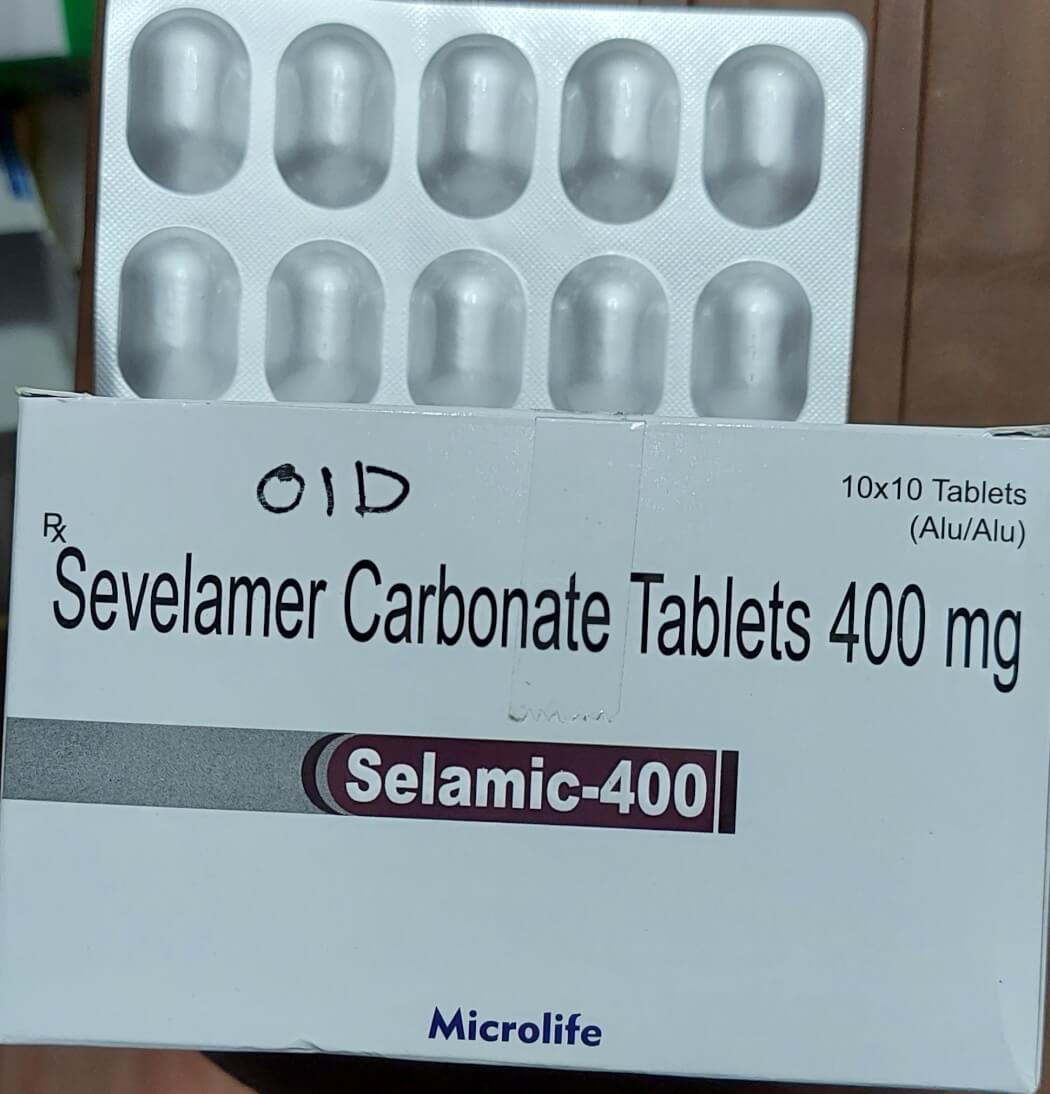
- It was the first phosphate binder that is calcium-free, metal-free, and not absorbed into the body.
- Beyond lowering phosphate, it also binds bile acids in the gut, which modestly reduces LDL cholesterol.
- None of it enters the bloodstream; the entire effect takes place within the intestinal lumen.
Mechanism
Sevelamer carries many amine groups along its polymer chain that become partially protonated in the intestine, allowing it to bind negatively charged phosphate ions through a combination of ionic and hydrogen-bonding interactions [2]. The captured phosphate is then carried out of the body in the stool instead of being absorbed, which lowers the phosphate load reaching the bloodstream [3]. Because the resin is not itself taken up into the circulation, it sidesteps the calcium accumulation associated with calcium-based binders, a property linked to less hypercalcemia and possibly to reduced progression of vascular calcification [1]. The same amine chemistry lets sevelamer bind bile acids in the gut, which accounts for its modest cholesterol-lowering effect [2].
receptor fingerprint
Dietary phosphate in the gut lumenbinds
Serum phosphate levelmodulates
Bile acids in the gutbinds
Mineral and bone axis (FGF23, PTH)modulates
Gastric and intestinal acid load (carbonate form)modulates
Dosingtypical ranges, not medical advice
interested in protocols and clinical dosages? make an account to see them! ^_^
Safetyrisks and cautions, not medical advice
Sevelamer is prescription only. Because it works entirely in the gut, its side effects are mostly digestive: nausea, indigestion, bloating, gas, constipation or diarrhea, and rarely bowel obstruction. It can bind other medicines in the gut and reduce their absorption, so drugs like levothyroxine, ciprofloxacin and mycophenolate are separated from it by a few hours. It is not used when phosphate is low or when there is bowel obstruction, and it is taken with meals so it can catch phosphate from food.
Interactionsdocumented pairs only, not exhaustive
Sevelamer is a non-absorbed polymer that binds phosphate in the gut, and it binds a good deal else besides. Every important interaction is physical adsorption in the lumen, so it depends entirely on whether the two drugs meet there.
A single 2.8 g dose of sevelamer cut the oral bioavailability of ciprofloxacin by roughly half in healthy subjects, enough to compromise treatment and to select for resistance. Mycophenolate mofetil loses about 36 percent of its peak concentration and 26 percent of its exposure when the two are given together, which is a real concern in transplant recipients. Levothyroxine absorption falls as well; a volunteer study showed reduced thyroxine uptake, and post-marketing reports describe rising TSH and returning hypothyroid symptoms in dialysis patients on both, with sevelamer appearing to interfere more than other phosphate binders.
Reduced cyclosporine and tacrolimus concentrations have also been reported. Sevelamer binds bile acids, so fat-soluble vitamin status can drift down with long use, and in animal work the same polycationic chemistry reduced absorption of raltegravir.
Checking a whole stack? Run it through interactions + stacks.
History
Sevelamer was developed in the 1990s by GelTex Pharmaceuticals of Waltham, Massachusetts, which set out to create a phosphate binder that was neither absorbed into the body nor based on calcium or metal ions. The result was a cross-linked polymer bearing many amine groups that trap dietary phosphate within the gut. Sevelamer hydrochloride was approved by the United States Food and Drug Administration in 1998 and marketed as Renagel, making it the first non-absorbed, calcium-free, metal-free phosphate binder for people with advanced kidney disease. The technology later passed to Genzyme, and a better-tolerated carbonate form, sevelamer carbonate, was introduced under the name Renvela. It is used chiefly to control high blood phosphate levels in patients on dialysis.
Reputation
Sevelamer is a well-regarded phosphate binder that filled a real clinical need by controlling serum phosphate without adding to the body's calcium load, an advantage over the older calcium-based binders. This distinction matters because studies have linked calcium-free binding to less hypercalcemia and to potentially slower progression of vascular calcification, a serious concern in advanced kidney disease. As a bonus, its amine chemistry also binds bile acids in the gut, giving it a modest cholesterol-lowering effect. It is not without practical drawbacks; the pill burden can be substantial, gastrointestinal side effects are common, and it is more expensive than calcium salts, while a definitive mortality benefit has been difficult to prove in trials. Even so, it remains a mainstay option for managing hyperphosphatemia in dialysis patients.
Subjective profileweighing the evidence above
A well-chosen drug for its job; it controls phosphate in advanced kidney disease without adding to the calcium load, and the LDL drop is a free bonus. Constipation and bloating are the usual price, and it binds other medicines in the gut, so levothyroxine and some antibiotics need spacing out.
Where to buy

Suppliers
Vendors carrying Sevelamer, with live product details and codes. Links are affiliate links that support the wiki at no cost to you.
PCT.Zone
Sevelamer
Research
- 2009first citedThe control of hyperphosphatemia in chronic kidney disease: which phosphate binder?
- 2025most recentPhosphate binders for preventing and treating chronic kidney disease-mineral and bone disorder…
- 1.Phosphate binders for preventing and treating chronic kidney disease-mineral and bone disorder (CKD-MBD)
- 2.Phosphate binders in chronic kidney disease: a systematic review of recent data
- 3.The control of hyperphosphatemia in chronic kidney disease: which phosphate binder?
- 4.Oral phosphate binders
- 5.Hyperphosphataemia: treatment options
5 listed here; entry last updated August 2026
Reviews
My notesprivate to this device
FAQ
Why do I take it with meals?
It has to be in the gut at the same time as food so it can bind the phosphate from what you eat.
Why sevelamer instead of a calcium based binder?
Sevelamer controls phosphate without adding a calcium load, which helps avoid the calcium buildup that can worsen blood vessel calcification.
Does it really lower cholesterol?
Yes, it also binds bile acids in the gut, which modestly lowers LDL cholesterol as a bonus.
Can I take my other pills at the same time?
Some medicines like thyroid pills and certain antibiotics should be spaced apart, since sevelamer can bind them and cut their absorption.
What is the difference between Renagel and Renvela?
Renagel is the hydrochloride salt and Renvela is the carbonate salt; the carbonate form also helps buffer the acid buildup of kidney failure.
Adverse effects
- constipation, diarrhea, or nausea
- abdominal discomfort or bloating
- risk of overly low phosphate if used beyond need
Notes and cautions
- a sizable pill count that can make adherence harder