
spec sheet12 rows
Rizatriptan is a medication of the triptan class, a group of serotonin receptor agonists used to treat acute migraine attacks. It relieves the pain and associated symptoms once a migraine has begun but does not prevent future attacks. Taken by mouth as tablets or as an orally disintegrating form, it is sold under brand names including Maxalt.
- Treats acute migraine attacks once the pain has begun
- Relieves the pain and the associated symptoms with it
- One of the better oral triptans for stopping an attack
- An orally disintegrating form that needs no water
- A real advantage once migraine nausea has set in
- Sold as Maxalt in tablet and melt form
- Dizziness
- Drowsiness or fatigue
- Nausea
Overview
Rizatriptan is a selective agonist of the serotonin 5-HT1B and 5-HT1D receptors and is classed among the triptans, the standard drugs for aborting migraine attacks. Chemically it is a substituted tryptamine, related in structure to the neurotransmitter serotonin, carrying a triazole ring on the indole framework [1]. Within its class it is regarded as one of the faster-acting and more effective oral options for stopping an attack [2].
The drug was patented in the early 1990s and introduced for medical use in 1998, having been developed by Merck. It is a prescription-only medicine that is now widely available in generic form and remains among the more commonly prescribed migraine treatments [1]. It is marketed under names such as Maxalt and, in an orally disintegrating version, Maxalt-MLT, with a dissolvable film formulation sold as Rizafilm [2].
Rizatriptan is indicated for the acute treatment of migraine attacks, with or without aura, in adults, and it is also used in adolescents. Comparative trials and reviews have found it to provide rapid freedom from pain and to perform favorably against several other triptans as well as older therapies [1]. A large network meta-analysis of acute migraine drugs ranked rizatriptan among the most effective oral options for achieving pain freedom, alongside eletriptan, sumatriptan, and zolmitriptan [4]. It sits within a broader menu of acute treatments that clinicians tailor to the severity and features of each patient's attacks [3].
Rizatriptan is taken by mouth, either as a conventional tablet, as an orally disintegrating tablet that dissolves on the tongue without water, or as a thin oral film. It is meant for use once an attack has started rather than on a regular schedule, and it does not reduce how often attacks occur [3].
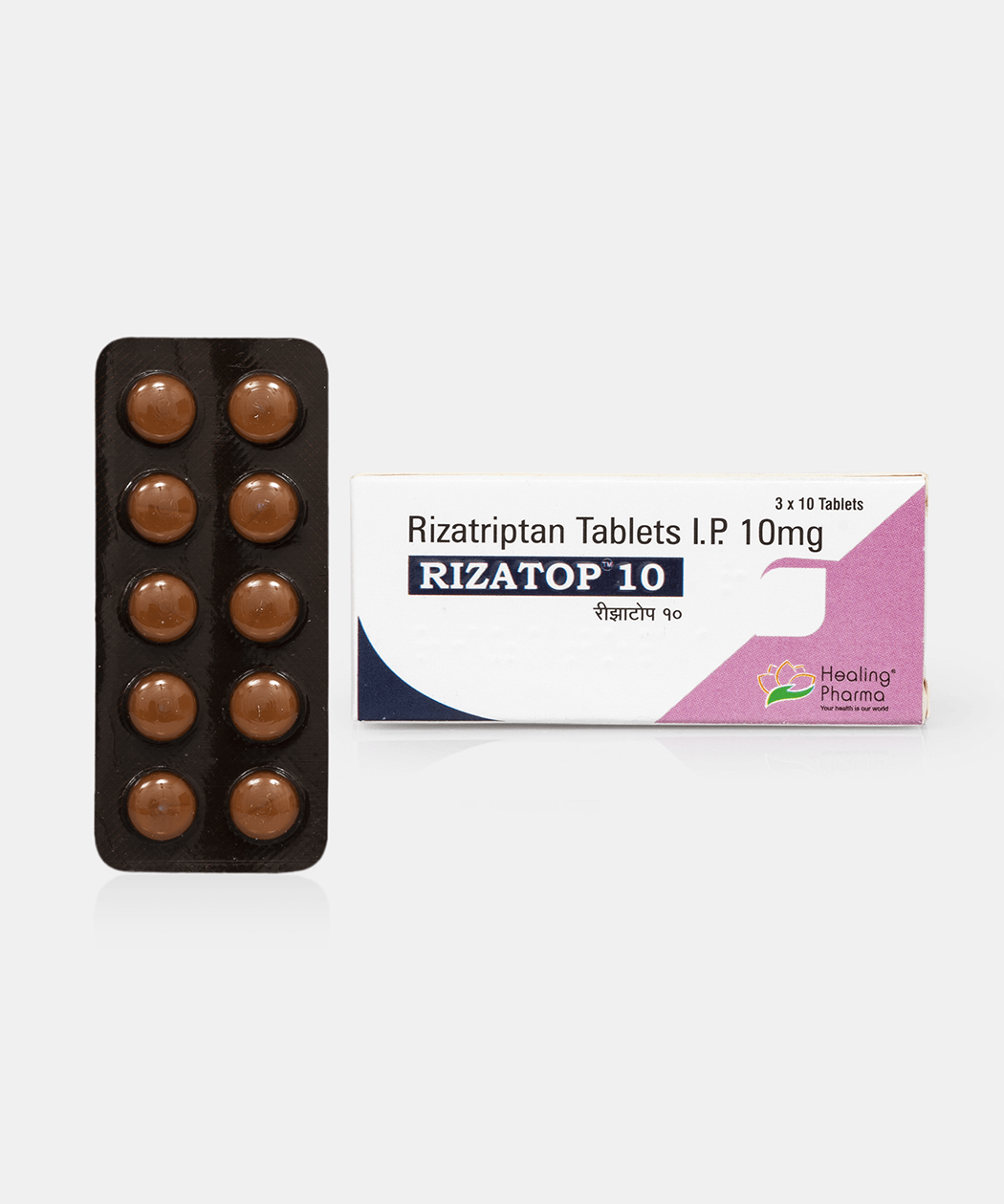
- In network meta-analyses comparing the oral triptans, rizatriptan consistently ranks among the most effective for delivering rapid, sustained migraine relief.
- The orally disintegrating Maxalt-MLT tablet dissolves on the tongue without water, a design meant for patients too nauseated to swallow a conventional pill.
- Rizatriptan aborts a migraine already in progress but has no preventive effect, so it is dosed at the onset of an attack rather than daily.
Mechanism
Rizatriptan relieves migraine by activating 5-HT1B and 5-HT1D receptors, the same targets shared by the other triptans. Stimulating 5-HT1B receptors on vascular smooth muscle constricts the dilated blood vessels within the cranial circulation that are thought to contribute to migraine pain [1]. Acting on 5-HT1D receptors on the sensory nerve endings of the trigeminal system, it is believed to reduce the release of calcitonin gene-related and other inflammatory neuropeptides, damping the transmission of pain signals [2]. Through these combined vascular and neuronal actions the drug interrupts an attack in progress rather than preventing future ones [3].
receptor fingerprint
5-HT1B receptoragonist
5-HT1D receptoragonist
CGRP release from nerve endingsinhibits
Trigeminal nucleus transmissionblocks
Meningeal blood vesselsmodulates
Dosingtypical ranges, not medical advice
interested in protocols and clinical dosages? make an account to see them! ^_^
Safetyrisks and cautions, not medical advice
Rizatriptan is prescription only, and because it constricts blood vessels it is not for everyone. It is contraindicated in people with coronary artery disease, prior heart attack or stroke, uncontrolled high blood pressure, and certain other vascular conditions, since the vasoconstriction could reduce blood flow to the heart or brain. Common side effects are chest or throat tightness, tingling, dizziness, drowsiness, and flushing; the chest tightness is usually benign but must be taken seriously in anyone with heart risk. It should not be combined with ergotamine drugs or another triptan within 24 hours, and caution is needed with drugs that raise serotonin because of a small serotonin syndrome risk. People taking propranolol need a lower dose since it raises rizatriptan levels.
Interactionsdocumented pairs only, not exhaustive
The best characterized interaction is with propranolol. Rizatriptan is cleared largely by monoamine oxidase A, and propranolol inhibits that pathway; in healthy volunteers, propranolol raised rizatriptan AUC by about 67% and peak concentration by about 75%. The effect is specific to propranolol, since nadolol and metoprolol studied the same way did not alter rizatriptan pharmacokinetics at all.
The same mechanism makes MAO-A inhibitors a contraindicated pairing, including phenelzine, tranylcypromine, isocarboxazid, moclobemide and linezolid; exposure rises considerably more than with propranolol.
Ergotamine, dihydroergotamine, methysergide and other 5-HT1 agonists share rizatriptan's vasoconstrictor action, and using them close together compounds coronary and peripheral vasospasm.
SSRIs and SNRIs carry a serotonin syndrome warning alongside triptans, though the reported case rate is low and the strength of that association is still debated.
Checking a whole stack? Run it through interactions + stacks.
History
Rizatriptan was developed by Merck & Co. as a second-generation triptan, part of the wave of serotonin 5-HT1B/1D receptor agonists that followed the pioneering success of sumatriptan. It was engineered for rapid oral absorption and good bioavailability, giving it a relatively fast onset among the oral triptans. The United States Food and Drug Administration approved it in 1998 under the brand name Maxalt, and it was also offered as an orally disintegrating tablet, Maxalt-MLT, that dissolves on the tongue without water. Its clinical program established that it could relieve migraine pain and associated symptoms such as nausea and light sensitivity in a substantial share of patients. It has since become a generic and remains one of the more commonly prescribed triptans for the acute treatment of migraine attacks.
Reputation
Rizatriptan enjoys a strong reputation as one of the faster-acting and more reliably effective oral triptans, a distinction supported by head-to-head analyses of the class. Patients often value its speed of relief and the convenience of the melt-in-the-mouth formulation, which is useful when nausea makes swallowing pills or drinking water unappealing. Because it targets the trigeminovascular mechanisms of an attack in progress, it can abort migraines that are already underway rather than merely dulling the pain. It does not prevent future attacks, and it shares the class cautions of the triptans, including a need for care in people with significant cardiovascular disease and a risk of medication-overuse headache with frequent use. For the many people whose migraines respond to it, however, it offers dependable, well-studied relief and a welcome return to normal function.
Subjective profileweighing the evidence above
One of the better oral triptans for stopping an attack already underway, and the melt-in-the-mouth form is a real advantage once nausea has set in. It does nothing preventive, and because it constricts blood vessels it is off-limits with coronary disease, prior stroke or uncontrolled hypertension.
Where to buy

Suppliers
Vendors carrying Rizatriptan, with live product details and codes. Links are affiliate links that support the wiki at no cost to you.
PCT.Zone
Rizatriptan
Research
- 2002first citedRizatriptan: an update of its use in the management of migraine.
- 2024most recentComparative effects of drug interventions for the acute management of migraine episodes in adul…
- 1.Rizatriptan: an update of its use in the management of migraine.
- 2.Ten years of rizatriptan: from development to clinical science and future directions.
- 3.Acute Migraine Treatment in Adults.
- 4.Comparative effects of drug interventions for the acute management of migraine episodes in adults: systematic review and network meta-analysis.
- 5.Triptans in the Acute Treatment of Migraine: A Systematic Review and Network Meta-Analysis.
5 listed here; entry last updated August 2026
Reviews
My notesprivate to this device
FAQ
When should I take rizatriptan?
As early as possible once a migraine starts; triptans work best when taken at the first sign rather than waiting for the pain to peak.
Why do I feel tightness in my chest?
Triptans mildly constrict blood vessels, which can cause a harmless tight feeling, but it must be checked out in anyone with heart risk.
Can I take it every day to prevent migraines?
No; it is only for treating attacks, and using it too often can cause medication-overuse headache, so it is limited to a few days per week.
Is it safe with my heart condition?
It is not used in coronary artery disease, prior heart attack or stroke, or uncontrolled high blood pressure because of its vessel-narrowing effect.
Why is my dose lower on propranolol?
Propranolol slows the breakdown of rizatriptan and raises its levels, so the 5 mg dose with a daily cap is used.
Adverse effects
- Dizziness
- Drowsiness or fatigue
- Nausea
- Feeling of tightness or pressure
- Dry mouth
- Rare chest or throat discomfort