
spec sheet12 rows
Risedronate sodium is the sodium salt of risedronic acid, a nitrogen-containing bisphosphonate used to strengthen bone. It slows the cells that break down bone tissue and is prescribed to treat and prevent osteoporosis and to manage Paget's disease of bone. Taken by mouth, it is sold under brand names such as Actonel and Atelvia.
- one of the best evidenced osteoporosis drugs available
- cuts real spine fractures, not just scan numbers
- also lowers hip and other fractures
- builds measurable bone mineral density
- counters the bone loss driven by long term steroids
- flexible weekly or monthly dosing suits real life
- Heartburn or esophageal irritation
- Abdominal pain or nausea
- Muscle or joint aches
Overview
Risedronate is a member of the bisphosphonate family, a group of drugs that bind tightly to bone mineral and curb its breakdown. It belongs specifically to the nitrogen-containing subclass, which is more potent than the older bisphosphonates, and it is usually supplied as the sodium salt, risedronate sodium [1]. The molecule carries a pyridine ring on the carbon that bridges its two phosphonate groups, a feature that gives it high potency together with a relatively low affinity for bone matrix, so that its effect on bone turnover fades comparatively quickly once treatment stops [1].
The compound was discovered under the code NE-58095 by researchers at the Cincinnati Miami Valley Laboratories and the Norwich Eaton Laboratories of Procter & Gamble. It was first approved in 1998 for Paget's disease and, after further trials, was cleared in 2000 for the prevention and treatment of postmenopausal and glucocorticoid-induced osteoporosis, and later for osteoporosis in men [1]. It has been marketed as Actonel and, in an enteric-coated weekly form, as Atelvia, first through an alliance between Procter & Gamble and Sanofi and later by other companies, with generic versions following in subsequent years [1].
In clinical practice risedronate is used mainly to lower the risk of fractures in people with osteoporosis, and treatment guidelines place bisphosphonates of this kind among the first-line options, often reserved for older patients or those at higher fracture risk [2]. Large phase 3 studies established that a daily dose raised bone mineral density and reduced the rate of vertebral and nonvertebral fractures, and once-weekly and once-monthly regimens were later developed to make dosing more convenient [1]. Alongside adequate calcium and vitamin D, exercise, and measures to prevent falls, it forms part of the broader management of age-related bone loss [3].
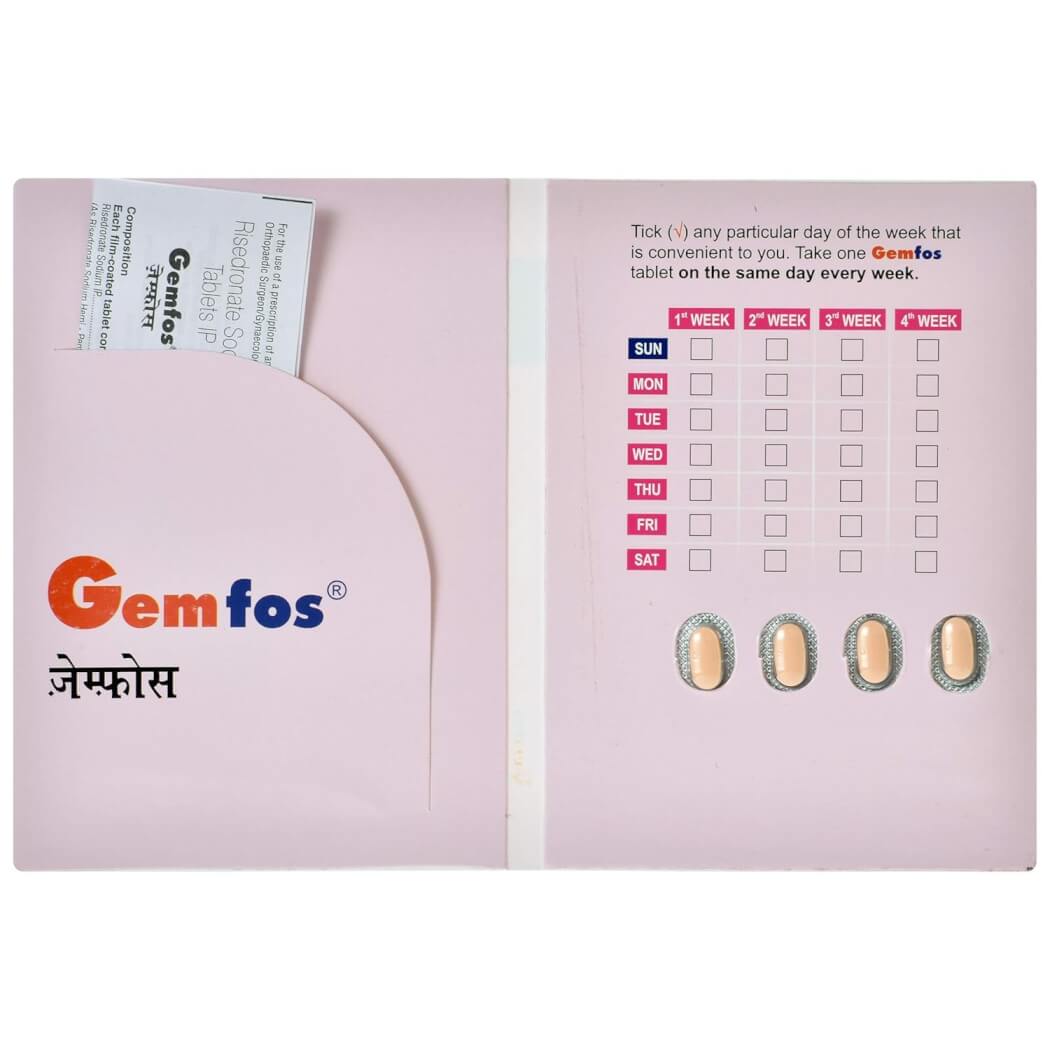
Risedronate is taken orally as tablets, including daily, weekly, and monthly preparations, and a formulation combining it with a calcium supplement has also been sold. Because food and drink sharply reduce its already poor absorption, standard tablets are taken on an empty stomach, while a later enteric-coated version was designed to be taken after a meal [1].
- The single nitrogen atom in risedronate's structure is what makes it far more potent than the first-generation bisphosphonates that lacked it.
- Because so little of an oral dose is absorbed, patients must take it on an empty stomach and stay upright afterward, a ritual central to the drug's effectiveness.
- Once bound to bone, bisphosphonates like risedronate can persist in the skeleton for years, which is part of why drug holidays are sometimes considered.
Mechanism
Like other nitrogen-containing bisphosphonates, risedronate works by binding avidly to the mineral surface of bone, where it is taken up by osteoclasts, the cells responsible for resorbing bone. Inside these cells it inhibits farnesyl pyrophosphate synthase, an enzyme in the mevalonate pathway that produces the lipids needed to modify key signaling proteins [1]. Blocking this step disrupts the osteoclast's internal machinery and cytoskeleton, reducing its capacity to break down bone and hastening its death [1]. The overall effect is a slower rate of bone resorption, which allows bone-forming cells to restore mineral density and lowers the likelihood of fracture [2].
receptor fingerprint
Farnesyl pyrophosphate synthaseinhibits
Osteoclastsinhibits
Bone hydroxyapatite mineralmodulates
Small GTPase prenylation (Ras, Rho, Rac)blocks
Bone remodeling balancemodulates
Dosingtypical ranges, not medical advice
interested in protocols and clinical dosages? make an account to see them! ^_^
Safetyrisks and cautions, not medical advice
Risedronate is prescription only. Its most notable issue is irritation of the esophagus, so it must be taken with a full glass of plain water while remaining upright for at least 30 minutes. Other effects include heartburn, abdominal pain and muscle or joint aches. Rare but serious risks with long-term use are osteonecrosis of the jaw and atypical femur fractures, and low blood calcium can occur if calcium and vitamin D are inadequate. It is not recommended when kidney function is poor (creatinine clearance under 30), and low calcium should be corrected before starting.
Interactionsdocumented pairs only, not exhaustive
Risedronate is a bisphosphonate used to treat osteoporosis. When taken together with nonsteroidal anti-inflammatory drugs (NSAIDs), the risk of upper gastrointestinal toxicity increases [5]. This is a pharmacodynamic interaction in which both the bisphosphonate and the NSAID can irritate the stomach lining, creating additive risk; the magnitude of this risk is similar to the background risk when NSAIDs are combined with placebo. Dosing instructions for risedronate (avoiding lying down for 30 minutes after ingestion, taking with a full glass of water) can reduce this upper GI risk and should be followed carefully to minimize harm. Few other documented interactions exist for risedronate; most other medications do not substantially alter its absorption or metabolism.
Checking a whole stack? Run it through interactions + stacks.
History
Risedronate was developed by Procter & Gamble Pharmaceuticals as a third-generation, nitrogen-containing bisphosphonate designed to bind bone mineral and suppress the cells that resorb it. It reached the United States market in 1998 under the brand name Actonel, initially for Paget's disease of bone and soon afterward for the treatment and prevention of postmenopausal osteoporosis. Its regulatory foundation rested on large randomized fracture-prevention trials that showed reductions in both vertebral and, in some populations, nonvertebral fractures.
The nitrogen atom in its side chain is central to its potency, allowing it to inhibit farnesyl pyrophosphate synthase within osteoclasts far more effectively than the earlier non-nitrogen bisphosphonates. A delayed-release formulation intended to ease the strict dosing requirements was later approved under the name Atelvia. Over time it became a widely prescribed and now generic option in the management of skeletal fragility.
Reputation
Risedronate is well established as an effective, evidence-backed treatment for osteoporosis, with a body of controlled trials demonstrating that it lowers the risk of the vertebral fractures that most threaten independence in older adults. Physicians appreciate that fracture benefits can appear relatively early in the course of treatment, and its long clinical track record gives prescribers confidence in its safety profile.
As an inexpensive generic, it remains an accessible first-line choice for many patients who need to preserve bone strength. Its main practical drawback is the demanding way it must be taken, on an empty stomach with a full glass of water while remaining upright, to protect the esophagus and ensure absorption. Rare long-term concerns such as atypical fractures and jaw osteonecrosis are recognized but uncommon, and for most patients the reduction in fracture risk clearly outweighs these possibilities.
Subjective profileweighing the evidence above
One of the better-evidenced osteoporosis drugs, cutting spine and hip fractures rather than just improving scan numbers, with flexible weekly or monthly dosing. The dosing ritual matters: a full glass of plain water and stay upright for half an hour, or the esophagus pays for it.
Where to buy

Suppliers
Vendors carrying Risedronate Sodium, with live product details and codes. Links are affiliate links that support the wiki at no cost to you.
PCT.Zone
Risedronate Sodium
Research
- 2002first citedOsteoporosis in elderly: prevention and treatment.
- 2018controlled trialEffects of teriparatide and risedronate on new fractures in post-menopausal women with severe o…
- 2021most recentMenopausal osteoporosis: screening, prevention and treatment.
- 1.History of risedronate.
- 2.Menopausal osteoporosis: screening, prevention and treatment.
- 3.Osteoporosis in elderly: prevention and treatment.
- 4.Effects of teriparatide and risedronate on new fractures in post-menopausal women with severe osteoporosis (VERO): a multicentre, double-blind, double-dummy, randomised controlled trial.
- 5.Alendronate and risedronate: what you need to know about their upper gastrointestinal tract toxicity.
5 listed here; entry last updated August 2026
Reviews
My notesprivate to this device
FAQ
Why must I stay upright after taking it?
Staying upright keeps the tablet from lingering in the esophagus, where it can cause irritation or ulcers.
Can I take it with coffee or juice?
No; use only plain water, because food and other drinks block absorption.
How long do people stay on it?
Often three to five years, then a doctor reassesses, since very long use raises rare jaw and femur risks.
Do I still need calcium and vitamin D?
Yes; adequate calcium and vitamin D are needed for it to work and to avoid low blood calcium.
Does weekly or monthly dosing matter?
Both work; the choice comes down to convenience and tolerance, with the same upright, empty-stomach rules.
Adverse effects
- Heartburn or esophageal irritation
- Abdominal pain or nausea
- Muscle or joint aches
- Headache
- Rare osteonecrosis of the jaw
- Rare atypical thigh bone fracture